

By the end of this century, China plans to replace coal furnaces with fusion reactors–using a parallel approach in which a dozen projects, public and private, compete to create a trillion-dollar market. Like the rest of the world, China has seen a surge in fusion companies developing key technologies and prototypes. Here’s the latest news on China’s front-runners:
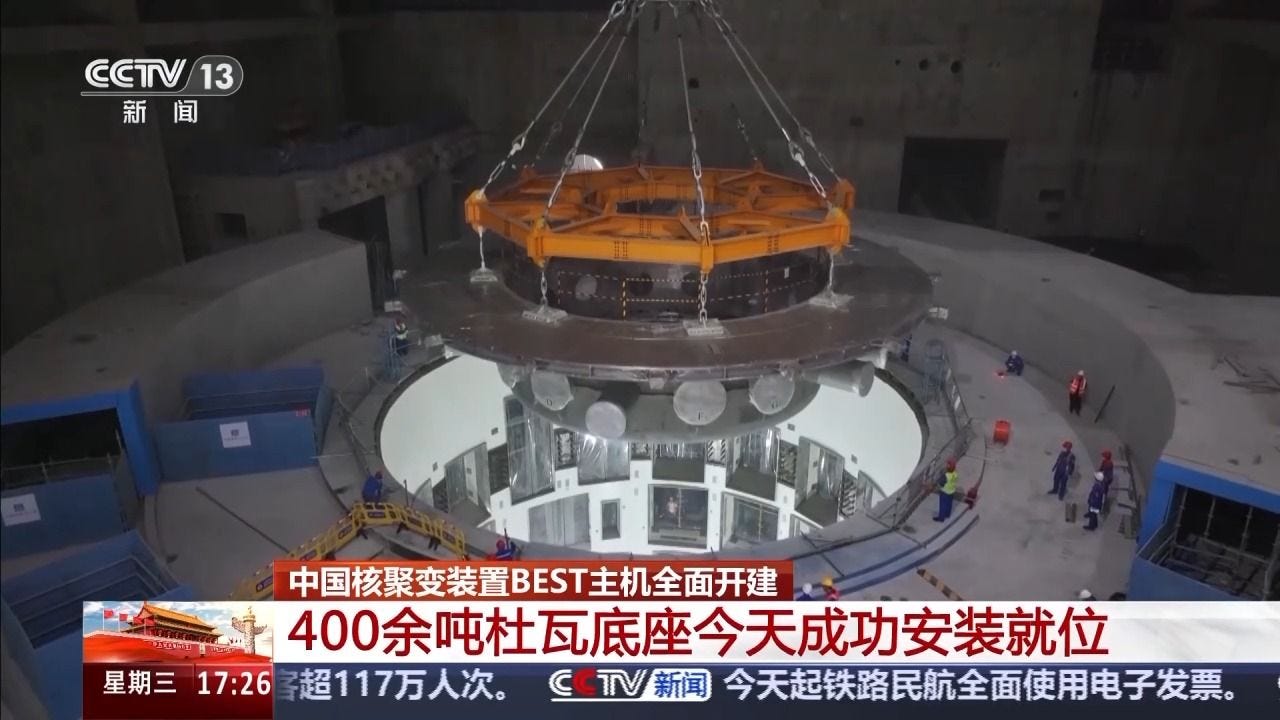
This post is for supporting subscribers. SorryBEST, Beijing’s fusion energy project, aims to sustain 5x net energy gain by 2027. This week it installed the cryostat base that maintains near zeroº for the superconducting magnets whose powerful fields confine and control the plasma during fusion. But big as it is, BEST is just one of many public and private fusion projects.
The biggest is CFETR, now a-building beside Hefei’s existing EAST tokamak. Though only a pilot plant, it will power a city of 2 million by the early 2030s.
Supporting it are world-leading research facilities like EAST and HL-2M, and a flourishing ecosystem of agile private companies, on tight budgets, struggling to develop cheap workarounds, alternative pathways, and novel technologies.
Private Enterprise?
Some of the more entertaining startups:
Energy Singularity, started in 2021, spent $1 billion to achieve first plasma with their HH70 tokamak. It’s 90% smaller, 95% cheaper, and 10x more energy-efficient than ITER, thanks to its home-made high-temperature superconductors. Overnight it turned a scientific curiosity into an engineering challenge.
Neo Fusion, which feeds into BEST, above, started assembling its flagship HTS tokamak reactor two months ago. Neo Fusion aims for a five-fold energy gain (Q=5) and stable deuterium-tritium plasma burning.
Hybrid Fusion-Fission combines fusion ignition with fission for enhanced efficiency. Its $2.7B Xinghuo (‘spark’) reactor in Jiangxi Province aims for 100 MW grid-connected power by 2030.
Mianyang Laser Fusion is a laser-based inertial confinement project using Z-pinch tech to simulate stellar conditions for energy and weapons research.
TAE Technologies, a US-based strategic partnership with China’s PA Group, is pursuing a beam-driven field-reversed configuration (FRC) approach–a simpler, more compact design with a reversed magnetic field created by plasma currents, not external coils.
Significance
Its integrated approach positions China–the only country with a complete, indigenous fusion supply chain–as the global leader, with a clear and well-funded path toward its goal of putting fusion power on the grid by the Republic’s centenary in 2050.
Commercial fusion, a clean, limitless energy source, will go a long way towards making our entire world cleaner and safer..