

As we saw in China’s Dollar Killer is a Stablecoin?, the US Treasury is playing defense against China’s mBridge, currency swaps and stablecoin. Now Beijing has opened a fourth front in its attack on dollar hegemony: paying for imports in gold. Tons of gold.
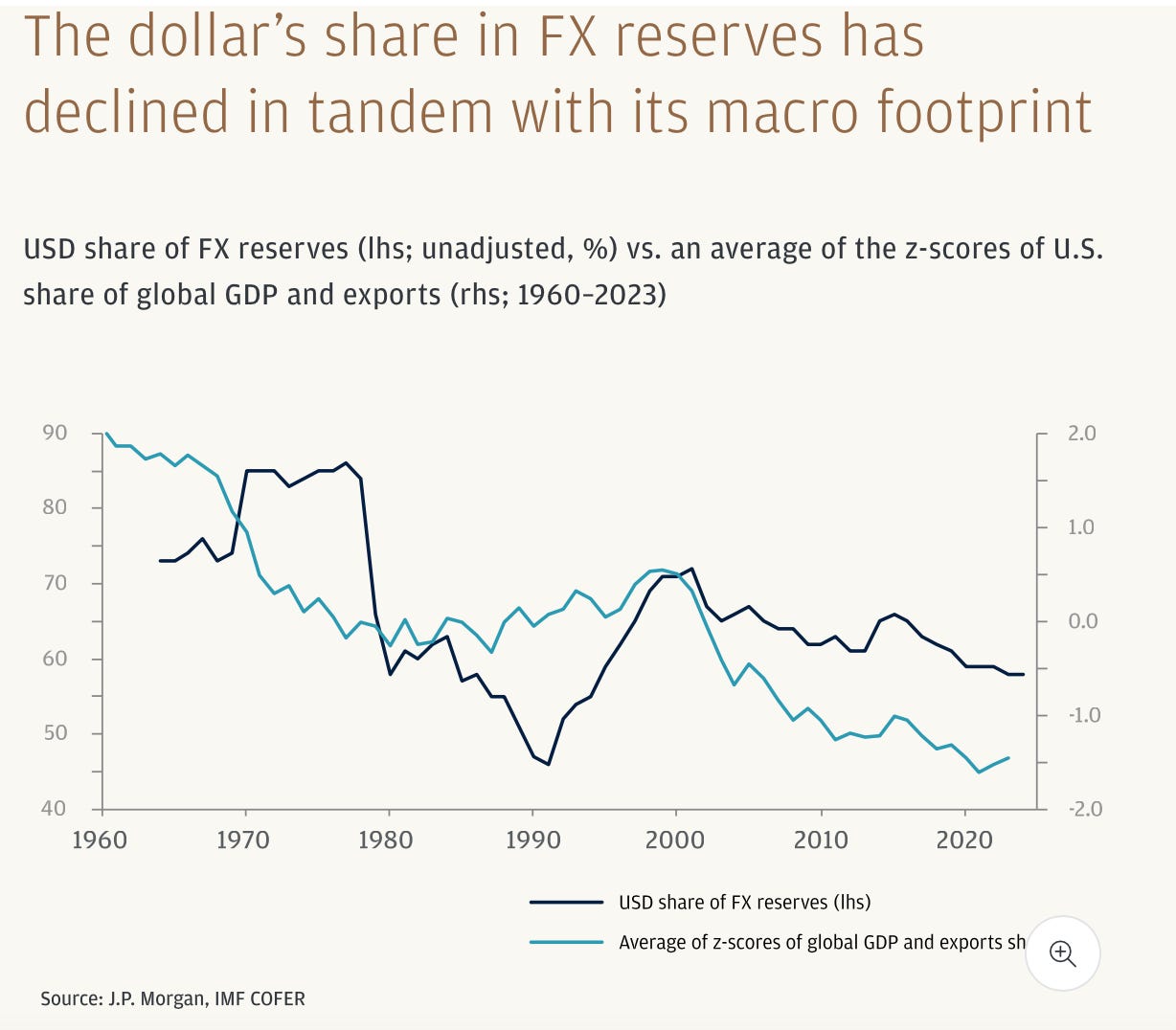
De-dollarization is unfolding in central bank FX reserves, where the share of USD has slid to a two-decade low. In fixed income, the share of foreign ownership in the U.S. Treasury market has fallen over the last 15 years, pointing to reduced reliance on the dollar. De-dollarization is most visible in commodity markets, where a large and growing proportion of energy is being priced in non-dollar-denominated contracts. – JP Morgan, July 01, 2025.
If you sell a supertanker of oil to a Chinese refinery for $240 million you’ll incur transaction costs in the millions: the dollar is losing value daily, SWIFT takes forever, will charge you $4.8 million and expose you to US Government scrutiny. “Or,” asks your Chinese buyer, “Shall we simply pay you in gold?”
How it works
The People’s Bank of China, with 2,250 tons of gold in its vaults worth $243,000,000,000, also owns the Shanghai Gold Exchange, the world’s largest physical gold trading floor. Your buyer will exchange your 1 million barrels of oil for 1.2 tons of gold, so the PBOC delivers your 1.2 tons to the International Gold Delivery vaults it also owns in Hong Kong, from where you can send it anywhere.
Big Picture
Gold for Oil is another strategic initiative to bypass dollar-denominated trade, reduce reliance on Western financial networks and secure energy supplies. It
weakens the petrodollar system that has propped up dollar demand since the 1970s and
encourages Iran, Saudi Arabia and Indonesia to accept non-dollar payments.
reinforces the idea of gold as a neutral reserve asset in the midst of currency wars
locks in oil supplies without FX risks
fuels the China-Russia-Iran commodity-backed financial bloc,
challenges Western monetary hegemony,
erodes dollar dominance,
protects sanctioned partners,
builds a parallel, gold-anchored trade system,
accelerates de-dollarization, a core BRICS strategic goal.
and above all, it’s working – JP Morgan testified.
Watch/Read
China is aggressively dumping U.S. Treasuries, building yuan trade systems, and creating alternatives to SWIFT. This isn’t symbolic. It’s systemic.
Cloud Capital–Yanis Varoufakis
The Creature from Jekyll Island. The creation of America’s privately owned Federal Reserve and its role in war-making.
Stablecoins: FDIC bailouts, redemptions and run risks: who bails out stablecoin issuers?
The stablecoin loophole that could expose the EU.
Stablecoins Are WORSE Than CBDCs! with Mark Goodwin.
As of July 17, 2025, BRICS consists of nine member countries: Brazil, Russia, India, China, South Africa, Egypt, Ethiopia, Iran, and the United Arab Emirates. The original five members (Brazil, Russia, India, China, South Africa) were joined by the four new members (Egypt, Ethiopia, Iran, UAE) on January 1, 2024. Saudi Arabia has not formally joined, but participates in some BRICS activities as a partner. Another 40 countries have expressed interest in joining, with 24 (including Algeria, Bahrain, Bangladesh, and others) formally applying for membership or invited as partner countries.
Please update your list of
"BRICS" countries to include Indonesia, which was added this year.
INDY