

Nowadays, all Chinese cities have safe streets, world-class schools and– thanks to national rail, water and power grids–cheap transportation, abundant water and power. And even Lhasa has excellent 5G1. These days, Chinese mayors earn promotions by weaving together the elements of urban life–including its natural endowments–to maximally enhancing every citizen’s life and, thereby, enhancing their productivity. The urbanization process is now so routine that busy mayors can simply buy CityBrain2 off the shelf. It’s a software package that runs cities a little better every day as its AI ‘brain’ trials different power and traffic strategies.
Next-level urbanization: dushiquan
So now that 200,000,000 rural folk are being smoothly urbanized, Beijing wants to lift urban productivity by a further 15% (the productivity advantage the Industrial Revolution conferred on 19th century Britain), by finding even bigger synergies in even bigger clusters of cities, dushiquan.
The dushiquan strategy was gestated in the 1990s and 2000s when rapid urbanization
bred productivity-reducing congestion, pollution, skyrocketing living costs and a gap between prosperous urban cores and an impoverished semi-rural periphery. The traditional model was concentrating resources and talent excessively, so planners began moving from a single-core, radiating structure to a multi-core, networked one. Instead of one dominant city, a dushiquan would consist of a core central city surrounded by functionally complementary small and medium-sized cities, forming an integrated economic and social sphere. Says Asia Development Bank’s Robert Guild, “Agglomeration reduces the costs of interaction, lowers costs throughout the supply chain and allows people to generate ideas as they serendipitously come into contact with others. Economists used to think there was an upper limit on efficient city size but there does not seem to be an upper limit on agglomeration economies. There does not seem to be an upper limit on city size”.
Beijing’s 2014 National New-Style Urbanization Plan made clusters the primary form of urbanization and the 13th Five-Year Plan (2016-2020) identified 19 key city clusters across the country. Guidelines for cultivating dushiquan emphasized deep integration of infrastructure, industries and public services and keeping all commutes under 60 minutes.
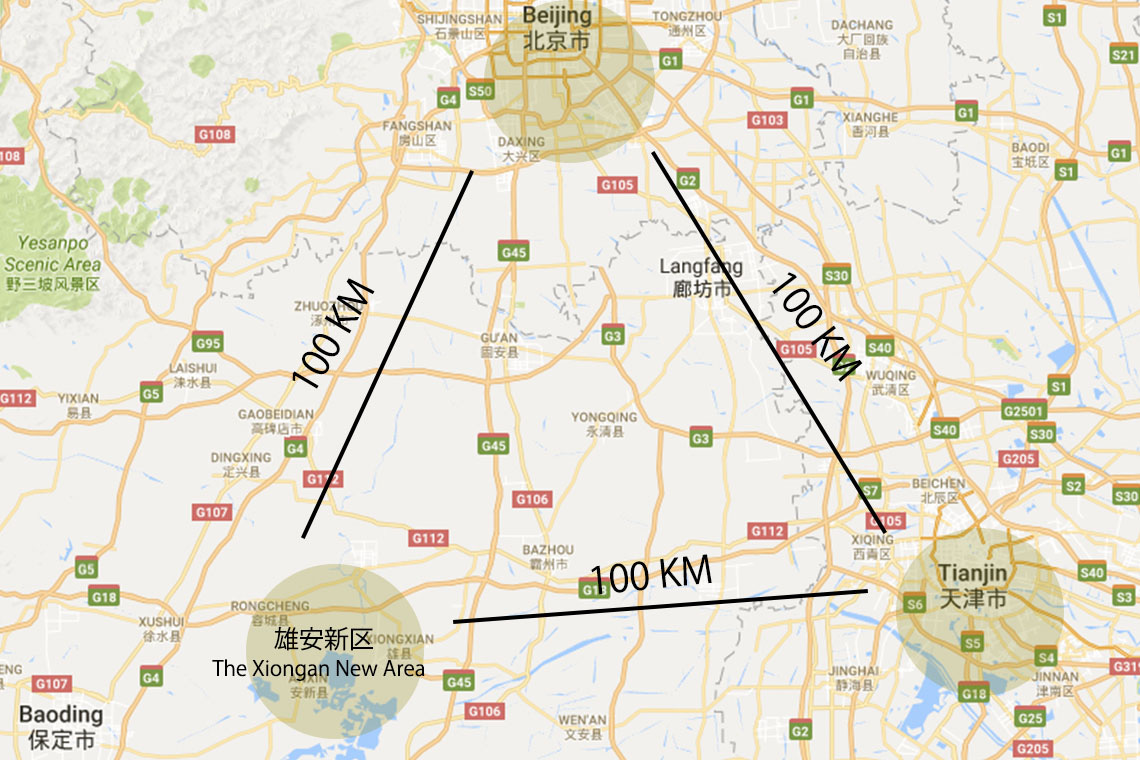
Currently, four dushiquan – Beijing, Shanghai, Guangzhou, and Shenzhen – collectively contribute 40% of national GDP, but the most visible success has been transportation. The high-speed rail network has been redesigned to shrink travel times within dushiquan to under 60 minutes, turning separate cities into nodes in a single, vast metropolitan area, encouraging the orderly transfer of industries from expensive urban cores to cost-effective neighboring cities. Beijing, for example, relocated numerous non-capital functions to Hebei province and the Xiongan New Area, allowing it to focus on high-end innovation while stimulating growth in its hinterland and lifted areas out of poverty through economic spill-over and targeted investment.
The biggest obstacle remains administrative segmentation between cities: different tax systems, regulatory standards (and local protectionism) hinder the free flow of capital, talent, and data, while concentrating economic activity in vast regions creates immense environmental challenges that demand complex cross-jurisdictional governance.
The Big Four
Four clusters are unique case studies in the art and science of managing human agglomeration in the 21st century, and their experiments could define the future of urbanization this century.
The Guangdong-Hong Kong-Macao Greater Bay Area (GBA), the most ambitious, is integrating ‘one country, two systems’ into a single, world-class cluster. It is pioneering cross-border flows of data, capital, and talent, harmonizing professional standards, and creating a collaborative innovation ecosystem. The GBA is a test bed for managing deep integration across fundamentally different legal and economic systems.
The Yangtze River Delta (YRD) Demonstration Zone is experimenting with unified planning, a shared public service system and integrated environmental management. It’s tackling administrative barriers head-on, trying to create ‘cross-provincial governance without administrative merger’.
Xiongan New Area, a greenfield project in Beijing’s Jing-Jin-Ji dushiquan, is a built-from-scratch laboratory of smart city technologies, green building standards and urban governance. Planners designed Xiong’an around 5G, IoT, AI, big data cloud computing, smart sensors, smart lighting and integrated facial recognition. Locals expect no traffic jams because computers and remote-controlled, self-driving vehicles manage traffic automatically. Bigger than Greater London, it connects the world’s most prosperous city to its impoverished hinterland and re-houses industries incompatible with Beijing’s needs. Two-thirds of Xiong’an’s forty square miles are wetlands and forest and it features low-energy construction materials, light mass transportation and green urban pockets–with much of its transportation, water, and electricity infrastructure underground. Seven hundred miles of new commuter lines keep its urban centers, universities, factories, hospitals, offices, institutions and government departments within sixty minutes of each other and four high-speed lines connect to the three airports–Beijing Daxing, Tianjin, and Shijiazhuang–and the national high-speed rail network.
Urban takeoff?
While significant challenges in coordination and equity remain, the dushiquan strategy is already boosting national competitiveness. China’s 70% urban-rural ratio and $10,000 per capita GDP are now at the level when Japan’s economic takeoff began in 1970, and won’t reach 50% until 2049. By that time, 200 hundred million more people will be living in cities like Xiong’an and repaying their capital costs by boosting their productivity and taxes.
Reading
Is road infrastructure investment in China excessive? Evidence from productivity of firms. Zhigang Li, Mingqin Wu, Bin R. Chen.
One area of Beijing has 6G, prepping for the satellite communications era.
CityBrain is an AI-driven urban management platform that integrates data from cameras, GPS and public systems to optimize traffic, emergency response, and city operations. It’s deployed in over 20 cities including Kuala Lumpur, Malaysia, as a ready-to-implement solution for governments and municipalities.