

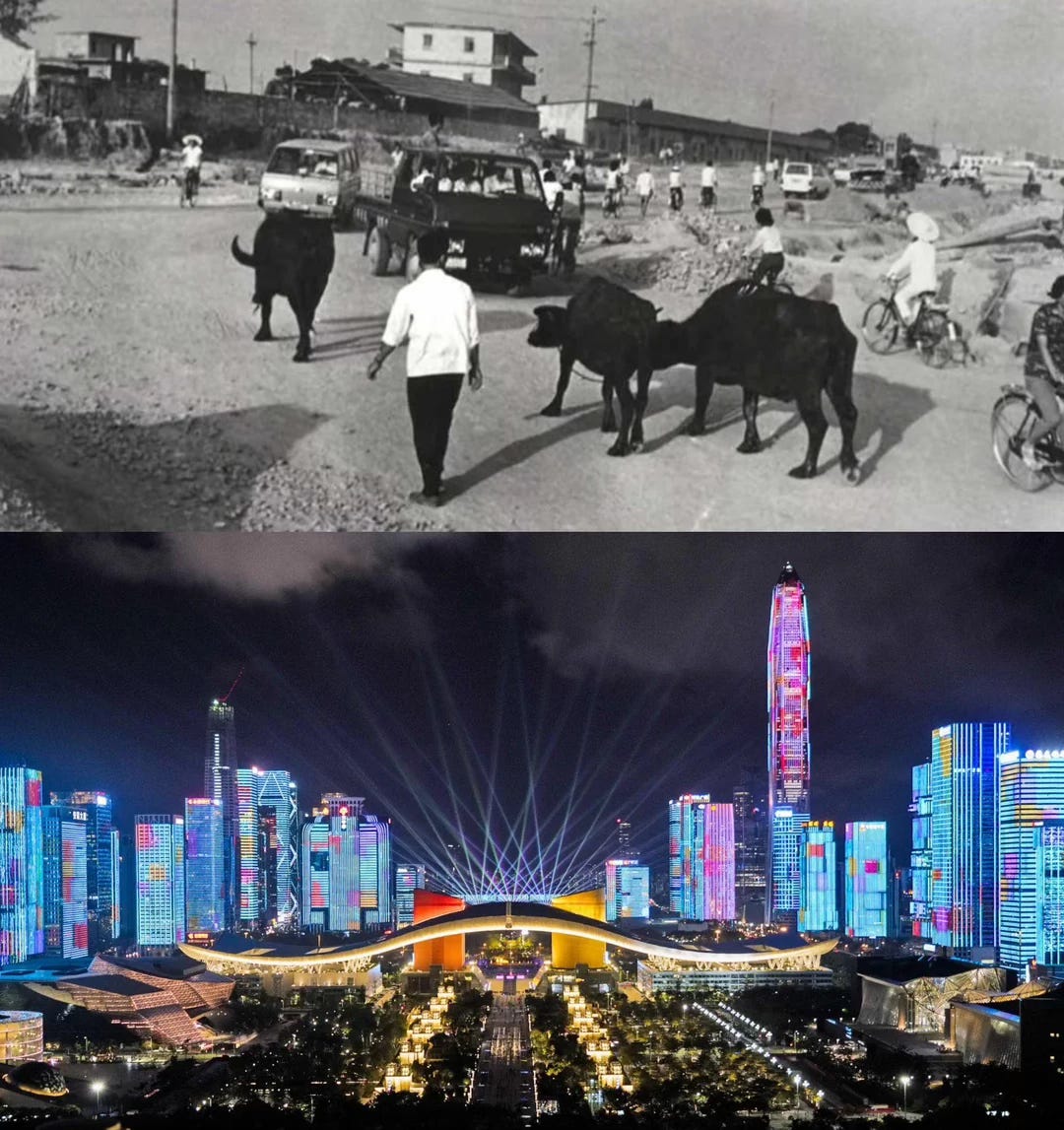
In 1997, when I stepped inside Shenzhen, I thought I had entered the Wild West. I described my experience in earlier posts. Child beggars, pimps, whores, scammers, thieves, pickpockets and gangsters were everywhere. Almost every official I was acquainted with spent their evenings in karaokes collecting stuffed envelopes, molesting young girls and drinking themselves to a stupor. Exceptions were few and far between. And the West said China was a repressive police state. From that point on, I would not believe anything the Western media and politicians say.
One of my first projects in China was building a new digital studio for the Changsha television station. I discovered that all high-tech equipment had to be shipped to China by extraordinary means. China couldn’t even produce standard cables. We had to import almost 100% of what we needed, including cables and connectors. At the time, China’s development was dependent on the West and had to follow the West’s rules.
As I said earlier, I went to Shenzhen with a Canadian friend. He never returned. I could have just as easily judged China as a hopelessly corrupt, uncultured and incapable country. It would be easy to judge because I was a well-educated Canadian. China needed people like me to help build its infrastructure and educate its officials. This kind of corruption comes with the territory. It was not specific to China but was common to all developing countries needing input from more advanced countries. It happened in Japan, South Korea and Taiwan when they were developing into Asian dragons. I heard lots of stories from people who did business in those countries during that era. Young women exchanged something they had to bring money to their
impoverished villages.
It is easy to say Deng Xiaoping corrupted China. I know many people who thought it and said it, including my father-in-law. He thought black cat-white cat meant one needn’t have principles. China did not become what it is today by keeping Mao’s closed agrarian society and letting the peasants take charge. I realized it was a very dangerous game to play.
The company I worked for has been established in China since 1981. I realized that it was not easy for China to get advanced equipment to build its infrastructure for development. Let’s say they needed a power turbine to generate electricity. They needed to buy it from ABB, which wanted payment in USD. China had none. What would you do? You borrow from Big Daddy, and you do what Big Daddy says. Hence, China borrowed money to develop local economies, but the condition was for the central government to relinquish power to the local governments to handle the money. And this is how local officials handling projects got corrupted. If you’re in charge of the tap, it’s hard not to get wet.
Big Daddy also says, your RMB exchange rate of 1.5 yuan to a dollar is ridiculous. The black market is at least four times that, if not more. I know, I was in China in 1981. If China were to be the manufacturer for American companies, the exchange rate should be somewhere around 8.5 yuan to a dollar. The trajectory took about 15 years, but the depreciation of the RMB was relentless, causing inexorable inflation. When teachers’ salaries could not rise in step, while merchants and high officials could do well, the students protested and clamoured for the return of the good old days (BDE, before the Deng Era). Then, regime-change operatives landed in Beijing and almost did the party in (I didn’t make this up; it’s now well documented). So, dying is easy; revolution is hard. To develop, you need the devil’s technology and money, and you need to do the devil’s bidding. Make a wrong step, and you’ll end up like Russia in the early 1990s
By the time China joined the WTO, the exchange rate had been around 8.3 yuan to a dollar for several years. Later, Big Daddy wanted to reduce the trade imbalance, and the RMB went from 8.3 yuan in 2005 to below 6 yuan over about two years. The appreciation was relentless, as Big Daddy wished. Blame Deng, I suppose.
When Xi Jinping came to power in 2013, I noticed something different. It was not only because of him but because China was ready. Hu Jintao wanted to achieve something, but was hampered. It took more than ten years, but China has become what it is today as a result of the work under Xi. I know the difference. I lived through it.
We may all have different personal experiences and opinions, but facts are stubborn things, from which we can seek truth. China cannot be what it is today without Deng. Playing this dangerous game with the devil, China and the CPC have survived and are on the road to full rejuvenation. While history is not coming to an end, the concern is now more about continuity and defending the future from human malfeasance. Humans are flawed, and as long as humans are in charge, the mistakes of the West are likely to be repeated. We need to understand the goal of the revolution and how to keep the fruits from going bad.
Peter Man.
Peter wrote Unconquered, his unvarnished impressions of China.