

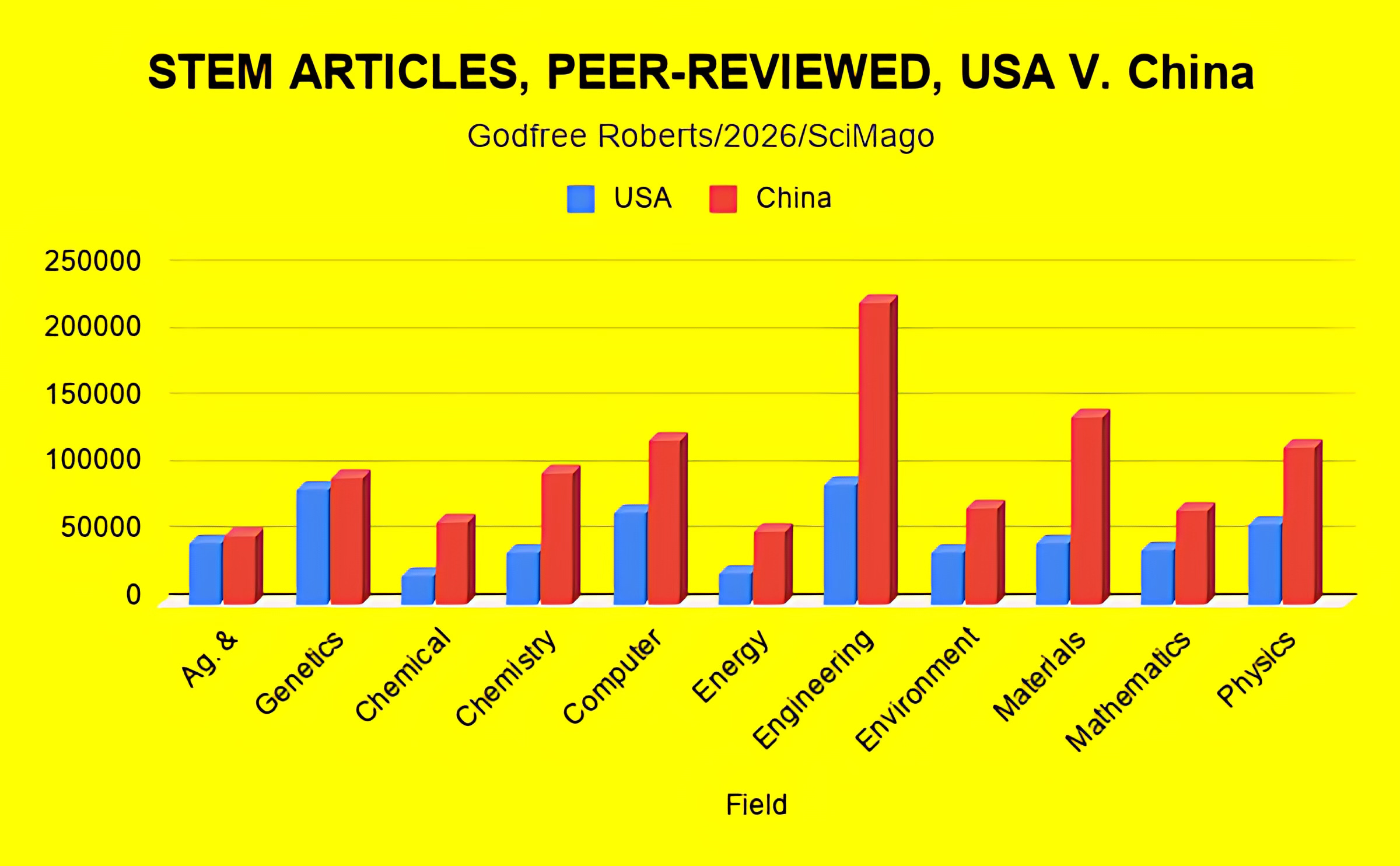
ASPI, funded by the US, UK, Japan, Canada, Lockheed Martin and Boeing, claims China leads the world in high-impact research in 69 of 74 critical technologies — up from 66 last year. In 41 technologies, China’s research papers generate 3 times greater impact than America’s and hold a near-monopoly. The list includes advanced data analytics, machine learning, brain-computer interfaces, advanced robotics, autonomous systems, advanced radiofrequency communication, digital twins, and wide/ultrawide bandgap semiconductors (where China holds 52% of global high-impact publications). China also leads in all nine broad categories, with recent gains in natural language processing and genetic engineering. The EU leads in only 3 technologies. The UK leads in none.
In reality, China dominates all 78.But ASPI created its own narrow criteria and largely ignored major international rankings such as SciMago and the Leiden Ranking. Here’s what those independent sources actually show:
In real life, China dominates all 78
To mollify its sponsors, ASPI created its own criteria and ignored international rankings agencies like SciMago and Leiden, which tell a very different story:
Neuroprosthetics? China leads in publication volume and high-impact output.
Geoengineering? Chinese institutions dominate high-impact papers (Leiden &
Quantum computing? China leads in high-impact research volume.
Vaccines and medical countermeasures? China produces far more high-impact papers than the US, and far more advanced vaccines.
Nuclear medicine and radiotherapy? China far surpassed the US in high-impact output.
Atomic clocks? China leads recent high-impact publications and leads in manufacturing them.
Small satellites? China now leads in high-impact research.
Advanced integrated circuit design and fabrication? China dominates high-impact papers in related semiconductor fields.
What experts are saying
China’s research leadership is no longer a trend; it’s a structural condition in most of the domains that will define military capability, economic competitiveness and technological sovereignty over the next two decades. Some experts:
Ilaria Mazzocco (Fellow, CSIS, DC). “China has made incredible progress on science and technology that is reflected in research and development, as well as in publications… it is ‘remarkable’ to see that China is so dominant and advanced in so many fields compared with the United States.”
David Lin (SCSP)
“One noteworthy finding is that China is outpacing the United States in cloud and edge computing… China’s research intensity in these fields probably reflects the urgency with which Beijing is moving AI from the lab into deployment.Senator Dave McCormick “Technological competition with China is a defining moment for global leadership—and that America’s success depends on the policy choices we make now.”
The awful truth
Like all US leaders, Senator McCormick won’t face facts: China’s research leadership is no longer a trend — it’s a structural condition in the domains that will define military capability, economic competitiveness, and technological sovereignty over the next two decades. China is so far ahead that we have no chance of catching them. So we bomb Iran.
The future
President Trump’s groveling to President Xi suggests that the future is already here:
“He’s now president for life. President for life. And he’s great. And look, he was able to do that. I think it’s great. Maybe we’ll give that a shot some day”. The Guardian.
“He’s a brilliant guy. He controls 1.4 billion people with an iron fist. I mean, he’s a brilliant guy, whether you like it or not.” Joe Rogan Experience
“I think China should help with Iran, too because China gets 90% of its oil from the Straits… It’s only appropriate that people who are the beneficiaries of the strait will help to make sure that nothing bad happens there.” Financial Times
Twenty years ago, David Graeber penned this prediction:
When United States was far and away the predominant world economic power it could afford to maintain Chinese-style tributaries. Thus these very states, alone amongst US military protectorates, were allowed to catapult themselves out of poverty and into first world status. After 1971, as US economic strength relative to the rest of the world began to decline, they were gradually transformed back into more old-fashioned sort of tributary. Yet China’s getting in on the game introduced an entirely new element.
There is every reason to believe that, from China’s point of view, this the first stage of a very long process of reducing the United States to something like a traditional Chinese client state and, of course, Chinese rulers are not–any more than the rulers of any other empire–motivated primarily by benevolence, there’s always a political cost and what that headline marked was the first glimmering stuff what that cost might ultimately be. –David Graeber. Debt, The First Five Thousand Years.
Two years ago
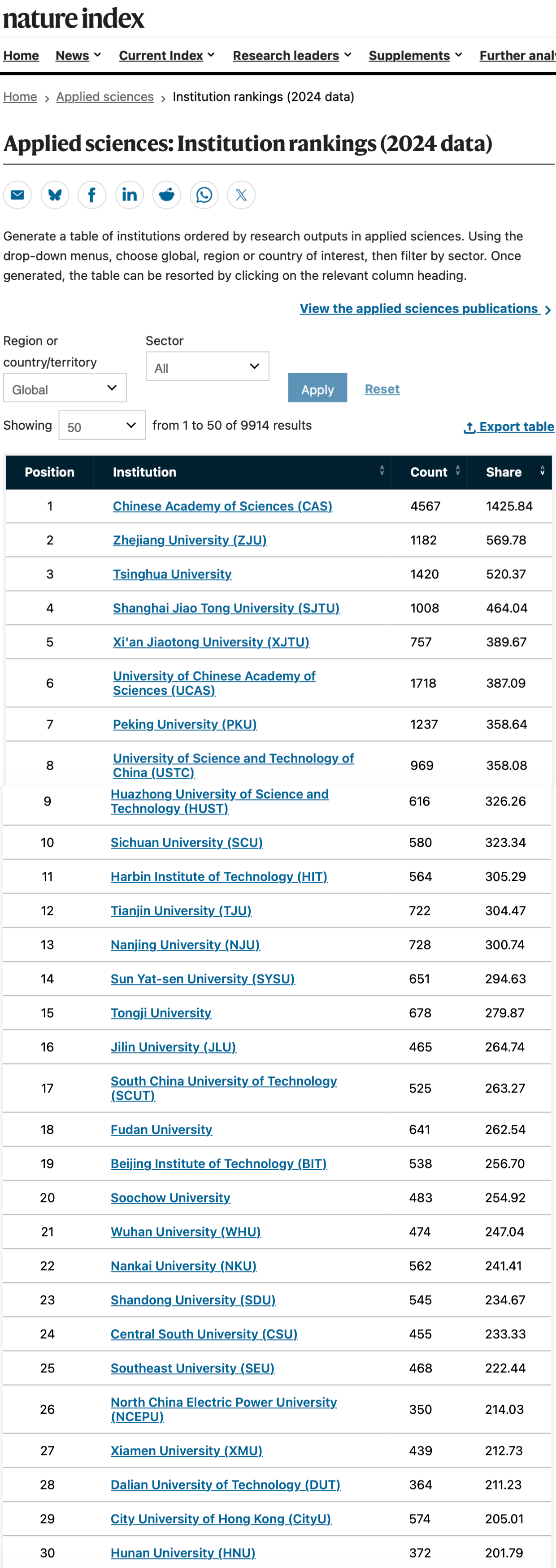
Chinese Science in 2024

China is building a 10MW demonstration thorium-based molten-salt reactor in the Gobi Desert, scheduled to be operational by 2030, after a successful building a 2-MW experimental version and operated since 2021.