

For years, China warned Washington that weaponising the global technology supply chain would have serious consequences. Quietly, consistently, and with remarkable restraint, Beijing issued statements, offered backchannel admonitions, and gently signaled that Washington’s escalation would not go unanswered. But Washington didn’t listen. Perhaps it couldn’t. The problem is not that the signs weren’t there, but because hubris and a racialised worldview rendered U.S. policymakers deaf to non-Western strategic reasoning and the subtle language of diplomatise. When Beijing spoke in the calm and coded language of diplomacy, without resort to hyperbole, it was interpreted not as resolve, but as retreat. As usual, restraint was mistaken for weakness. Warwick Powell
Officials in the Biden administration were so concerned about the U.S. military’s lack of a domestic samarium supply that they issued large contracts for the construction of two samarium production facilities. Neither was built because of commercial concerns, leaving the United States entirely dependent on China. NYT.
China has bound the USA over1 to 6 months good behavior. For the next 6 months, if the USA keeps its side of the deal they agreed in London, China will ship REMs to US factories that disclose in details how, how much and where their REM purchases will be used.
The Saudi Arabia of Rare Earths
Premier Li
Worldwide, annual sales of rare earths total just $5 billion, minuscule compared with $300 billion for copper or iron ore mining. Even worse, extracting rare earth minerals is a dirty, tiresome, environmentally fraught process, but turning the ore (dirt) into laboratory grade, high-purity metals and alloys entails intellectual property that only China possesses. And there’s something else China possesses: manpower.
Geologists galore
Rare earth chemistry programs are offered in 39 universities across the country, while the United States has no similar programs. China graduates 30,000 geologists each year, 3,000 of whom are PhDs, giving it a total of 500,000 active geologists2 and 60,000 PhDs3. The China University of Geosciences alone graduates 10,000 geologists annually.
Impact on U.S. Factories
Integrated Supply Chain Technologies:
China’s IP extends to vertically integrated supply chain technologies, from mining to finished products. This includes proprietary systems for ore beneficiation, smelting, and the production of high-value products like alloys and electronic components.
China’s patents cover integrated systems for tracking and optimizing REE production, such as the rare earth product traceability information system mandated by regulations effective October 1, 2024. These systems ensure state control over resources and enhance efficiency, giving China a competitive edge.
U.S. factories, particularly in tech and defense, lack access to such integrated systems, making it harder to compete with China’s cost-effective production. For instance, semiconductor manufacturers (e.g., those supplying Apple) face disruptions due to restricted access to processed REEs like gadolinium, critical for chip production. The absence of equivalent IP hinders U.S. efforts to build a self-sufficient supply chain.
Companies like Lockheed Martin and Boeing, reliant on REEs for radar systems and missiles, face risks of production delays as China’s licensing system delays exports. The U.S. Department of Defense’s goal of an independent REE supply chain by 2027 is hindered by the lack of comparable IP.
Factories producing electric vehicles (e.g., Tesla) and consumer electronics (e.g., Apple) are impacted by restricted access to magnets and processed REEs. China’s IP in magnet production and processing means U.S. firms cannot easily substitute with domestic alternatives, leading to potential cost increases and supply chain bottlenecks.
Manufacturers of MRI scanners and cancer treatment devices depend on REEs like gadolinium and yttrium, which are subject to export controls. Without access to China’s advanced processing IP, U.S. factories face challenges in securing stable supplies.
A U.S. Geological Survey report estimates that a total ban on certain critical minerals could result in a $3.4 billion GDP loss, with REE restrictions contributing significantly due to their role in high-tech manufacturing.
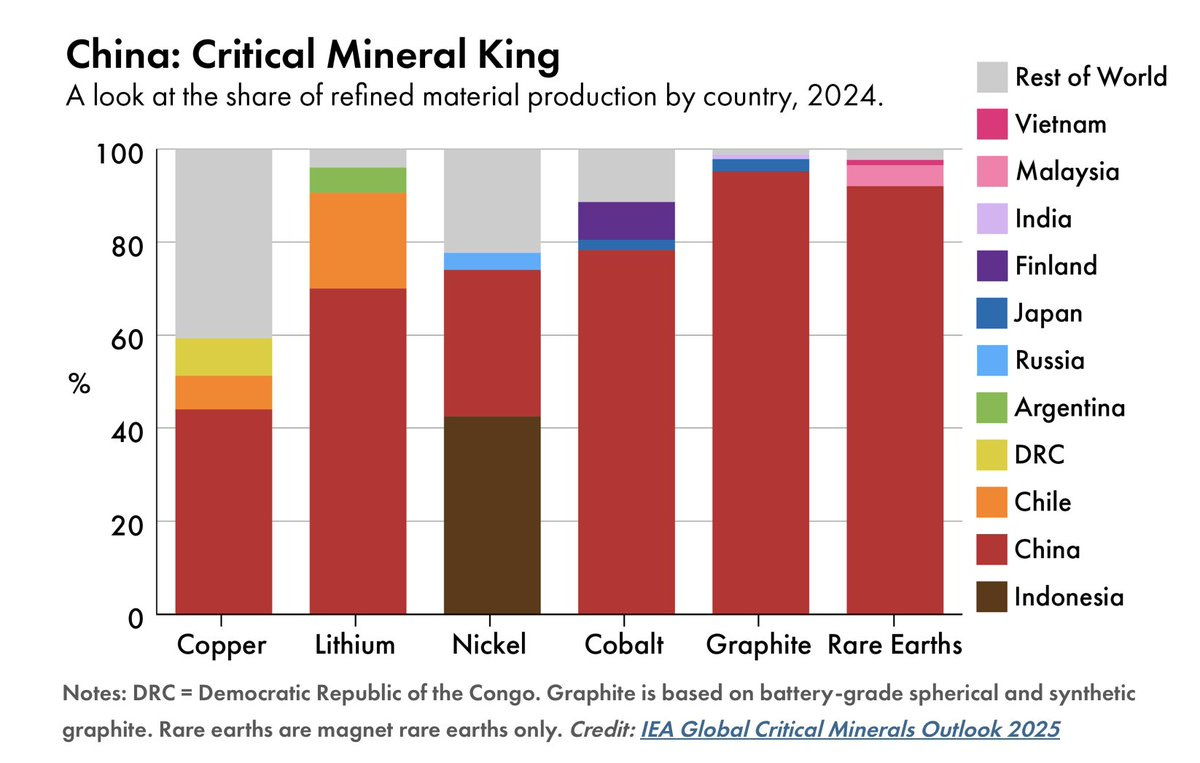
China’s significant IP in solvent extraction, magnet production, green recycling, and integrated supply chain technologies underpins its 90% control of global REE processing and 94% of magnet production. This IP advantage exacerbates the impact of its export restrictions on U.S. factories, particularly in defense, automotive, tech, and healthcare sectors, which face supply shortages and rising costs. While the U.S. is investing in domestic capabilities, the lack of comparable IP means it will take 5–10 years to close the gap, leaving factories vulnerable in the interim. Diversifying supply chains and accelerating R&D are critical to reducing dependence on China’s IP and mitigating ongoing disruptions
Who, precisely, will underwrite the construction of factories demanding two decades of unswerving political resolve, legions of scientists, millions of laborers and hundreds of billions of dollars in outlays year after grinding year? And what if, in the end, the enterprise yields neither a commercial profit… nor even a viable product?
Under UK law, someone is "bound over" by a court order requiring a person to pledge good behavior, often secured by a bond.
Including field geologists, researchers, and industry professionals
Of America’s 80,000 geologists, 25,000 have PhDs.
What is the current situation? Has China now backed off blocking all except samarium?
Fascinating and sobering read. The combination of China's intellectual property, state-backed integration, and vast geoscientific manpower gives it a nearly unassailable lead in rare earths. One question: Can the U.S. realistically build a competitive REE ecosystem without abandoning free-market orthodoxy?