

Diplomacy
Xi in Kazan: China will establish 10 overseas learning centers in BRICS countries to provide training opportunities for 1,000 education administrators, teachers and students.
India may accept some of the terms of BRICS de-dollarization but requires the privilege of withdrawal and settlement with individual countries. This demand for "customized participation" is obviously a challenge to the internal spirit of cooperation of the BRICS countries.
Geopolitics
Western states’ mobilization of funds for global infrastructure remains paltry, suggesting that Western states cannot contest Chinese dominance there. Why? Where state managers’ plans jibe with, or express, the interests of powerful social forces and the capital and productive forces they command, a powerful impact results. This is true of China. Conversely, where geopolitical ambitions are divorced from powerful groups’ interests and material realities, results are lackluster. This applies to the United States, characterized by infrastructural decay, industrial hollowing-out and a dominant financial sector largely disinterested in infrastructure. The West’s continued neoliberal approach still relies on the already-failed approach of mobilizing private capital into infrastructure investment.
China urges UK to return Malvinas Islands to Argentina. Geng Shuang, Deputy Permanent Representative to the UN, urged the UN 4th Committee at the 79th General Assembly and the international community to work together to address the harms of colonialism.
The Korean war broke out in July 1950 and, as US forces approached the Yalu River, China joined the war in late October in alliance with North Korea. Following this,
The U.S. and Britain seized Chinese assets—ships and planes in particular—in Hong Kong and other areas they controlled.
The US deployed the Seventh Fleet during the war to prevent a Chinese attack on Taiwan.
The United Nations embargoed Chinese goods until the armistice in 1953.
The prohibition on shipping goods from the US to China lasted until 1972.
China Finds Another U.S. Prism Program. The U.S. has seven monitoring stations across the country to intercept data transmitted through undersea cables in the Atlantic and Pacific. These data were analyzed and extracted in close collaboration with the FBI and the UK’s National Cyber Security Centre (NCSC), enabling the U.S. government to conduct indiscriminate surveillance on global internet users. The Chinese government also released a set of photos, showing that the U.S. installed surveillance equipment on the undersea cables, intercepting information through a special device and transmits the data back to the country. One of the key centers for this data transmission is the U.S. military base in Guam.
Defense
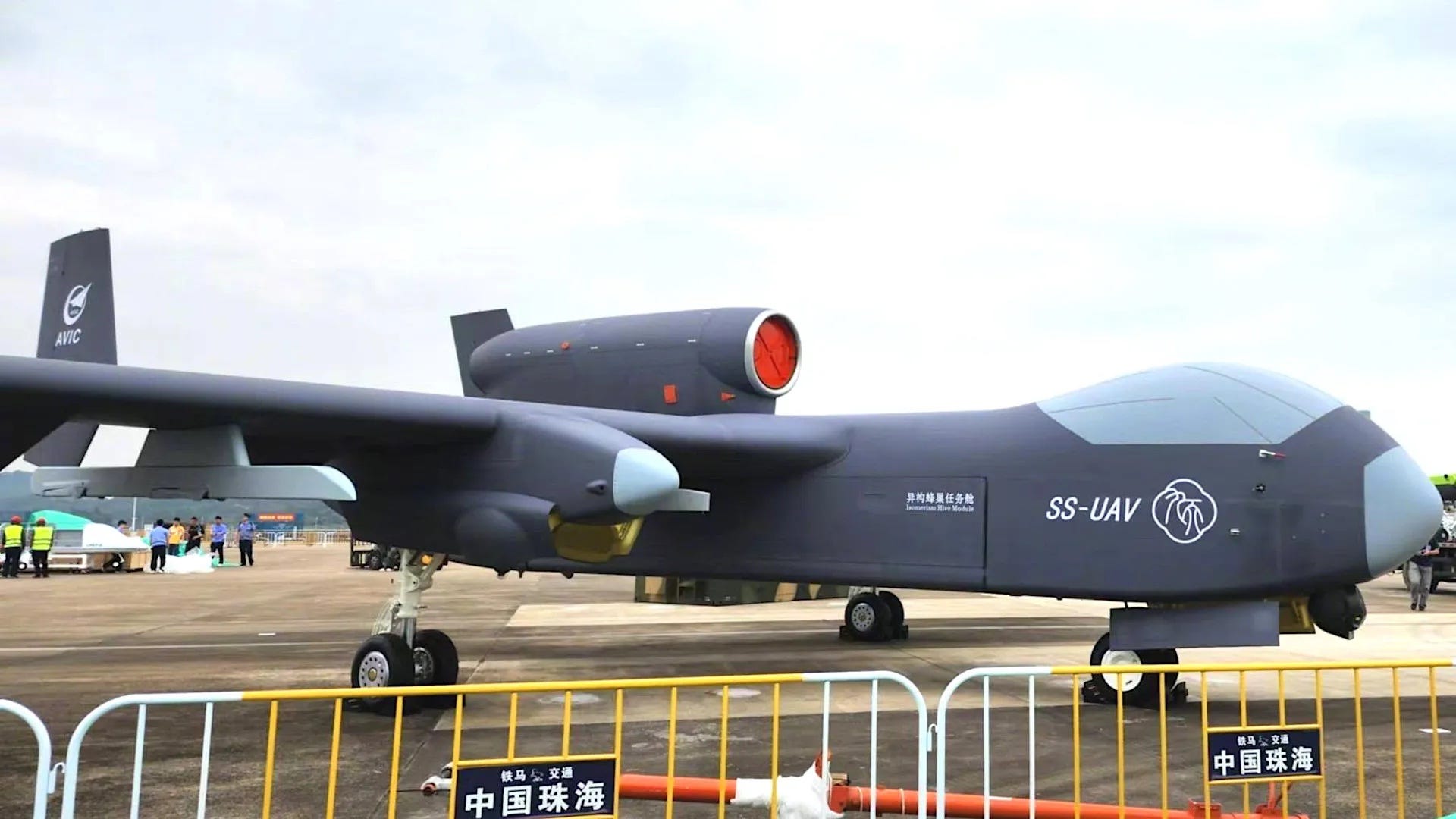
A very large, jet-powered drone, Jiu Tian (‘High Sky’) with a 10-ton MTO appeared at this year’s Zhuhai Airshow, fitted with a modular payload section designed to launch swarms of smaller uncrewed aerial systems. The MTO of the USAF MQ-9 Reaper is just under six tons.
The Ministry of State Security has seized "special technical devices built by foreign
intelligence agencies for reconnaissance and monitoring of our country's waters, intelligence collection and technical theft." The ministry said that it had discovered foreign-made "secret guards" that lurk on the seabed, collecting hydrographic data and monitoring passing shipping. Other devices act as "spies" and drift with the current, providing situational awareness. Others - "lighthouses" - appear to be designed to guide foreign submarines to navigate covertly through waters near China. "Faced with the severe and complex situation of covert struggle in the deep-sea security field and the real threat of foreign espionage intelligence agencies, the national security agencies will . . . firmly defend our sovereignty".
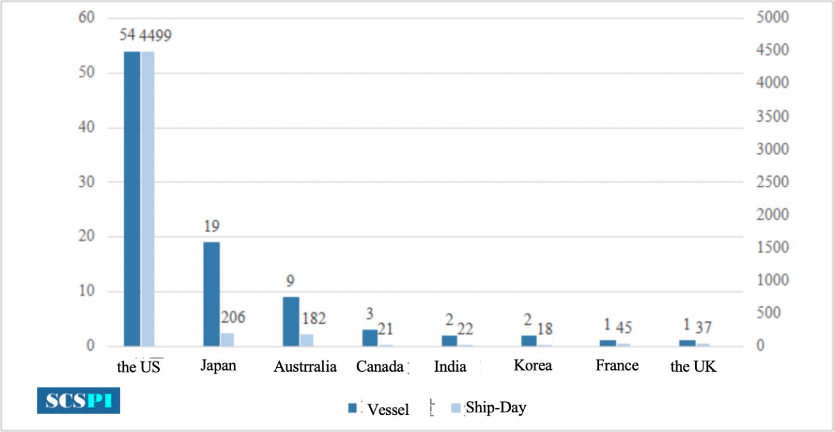
Around 50 warships are active in the South China Sea each day, among which 91 warships from extra-regional countries such as the US, Japan, Australia, South Korea, the UK, France, India and Canada collectively conducted activities totaling 5,030 ship-days in the South China Sea.
Military forces from both regional and external countries conduct over 20,000 ship-days and more than 30,000 aircraft sorties in the South China Sea annually, along with hundreds of large-scale drills and various exercises. There exists an international misconception that some coastal states, especially claimant states, unreasonably restrict military activities in the area. In reality, while coastal states generally do not welcome foreign military forces’ activities in their claimed waters, they mainly conduct tracking and surveillance and only resort to measures of a forceful nature in specific areas and circumstances. Overall, countries from both in and outside the region enjoy the freedom to engage in military activities in the South China Sea, as normal under international law.
RAND: “We believe the magnitude of the threats the US faces is understated and significantly worse. China is outpacing the US in defense production and growth in force size and, increasingly, in force capability and is almost certain to continue to do so. Beijing has largely negated the US military advantage in the Western Pacific through two decades of focused military investment. As US adversaries are cooperating more closely together than before, the US and its allies must be prepared to confront an axis of multiple adversaries.”
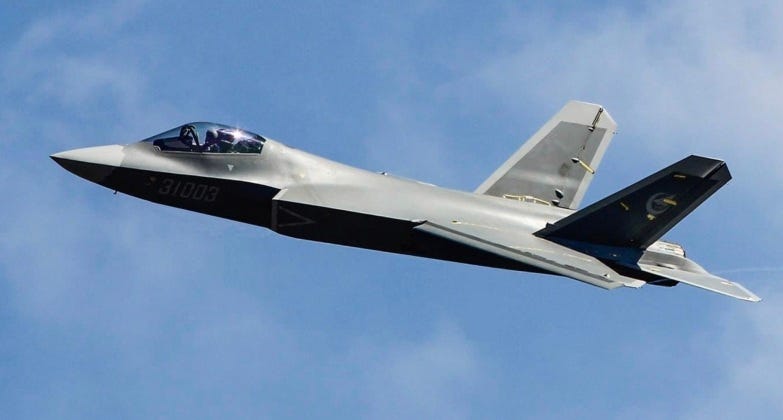
The new FC-31 has promising prospects on global export markets, with a higher degree of sophistication including far superior stealth capabilities and avionics compared to the Russian Su-57 and the upcoming South Korean KF-21 and far superior range and flight performance to the American F-35, while having far less restrictions and political conditions imposed on its use. It will be the world’s most capable fighter available on export markets, with only the F-35A having a serious chance of rivaling its capabilities.
China enjoys a sizable advantage in hypersonic weapon systems, with DF-17 missiles reaching Mach 10, which is 10 times the speed of sound. The key to developing them is to understand and predict the complicated aerial fluid dynamics at high velocity. Researchers have unveiled an innovative method that harnesses the power of quantum computers to revolutionize the world of computational fluid dynamics (CFD) and conducted the simulation at the largest scale to date (solving a 5043-dimensional matrix). This approach, detailed in a recent paper in Applied Mechanics and Engineering, promises to unlock new frontiers in fields ranging from aerospace engineering to climate modeling.
The Pentagon’s inflation-adjusted budget is 60% higher today than in 1975.
The Air Force had 10,387 aircraft in 1975 and today it has 5,288.
The Navy had 559 active ships in 1975 and 296 today.
America devotes ever greater resources to defense and receives ever less in return.
It's not just a less effective military. Declining marginal returns are common across many spheres of American civilization, cars, houses, trains, education, cinema, politicians. They can no longer build roads, subways, ships, or manufacture anything competitively.
The U.S. Navy’s surface fleet, still short of its readiness goal of 75 combat-credible surface ships at any given time, is pursuing new ways to boost its readiness. Kitchener declined to say how many ships were mission-capable. A Navy official told Defense News it was in the “low 50s” at that time.
how many people still remember "build back better world" (or something like that) - the supposed BRI competitor from the collective west with a few trillion dollar investment aspiration? Remind me of one such executed initiative and how much has been spent?
how many remember the "democracy summits" - the supposed pushback of "democracies" against "authoritarian regimes"? when was the last one held and what came out of it?
the rhetoric-spewing colonial states are giants in words but dwarfs in action. They are not to be taken seriously and don't feel an ounce of accountability for their verbal diarhea.
as for even domestic infrastructure, there is no appetite for new investment. Let's be honest here - the financialized capitalism in the west today, especially the US, is all about value extraction, not about building. When you can make risk-free money from financial engineering, why take on risky actual engineering? Profits are made through "owning assets" instead of "making things". The biggest disappointment of the wall street capitalists about China is that they cannot execute this gimmitry to control Chinese economy. This is why business interest is no longer an impediment for US confrontation with China. Of course, they can no longer compete against Chinese businesses in making cars, mobile phones, electronics, machinery, drones, ships, trains, and etc etc.
at the finish of the Zhuhai airshow, it feels time to add a few points -
1. the advance China has made in stealth and unmanned technologies is manifesting itself explosively - we are seeing WZ-7, WZ-8, WJ-700, Jiutian, CH-7, MD22, Killer Whale unmanned stealth drone ship, unmanned submarines, and many more. Stealth and unmanned tech is being incorporated in air, sea and land war theaters in numerous innovative combinations.
2. traditional Chinese strength in hypersonic missile technologies continue to accelerate with the introduction of GDF600 (a hypersonic glider bomb with submunnitions) and HQ19 air defense systems with 3000 KM range.
3. the famed A2AD concept is fully materialized with a multi-layered kill chain featuring numerous hypersonic air, sea and land-launched ballistic missiles including DF17, DF21, DF26, DF27, CJ100, YJ21 and more. This gives another meaning to the redudancy concept of overkill, ensuring virtually zero survivability of US carriers and other capital ships anywhere closer to Chinese shores than the second island chain.
in the law of the jungle reality of today's geopolitics like John Mearsheimer liked to point out, a couple of aircraft carriers at the bottom of the Pacific will shut up the belligerence of US politicians like marco rubio and lindsay graham. these clowns will never have their children in the US imperial army as cannon fodder but when they see their much-hyped military might fold like an origami, maybe they will stop their empty words of malice.