

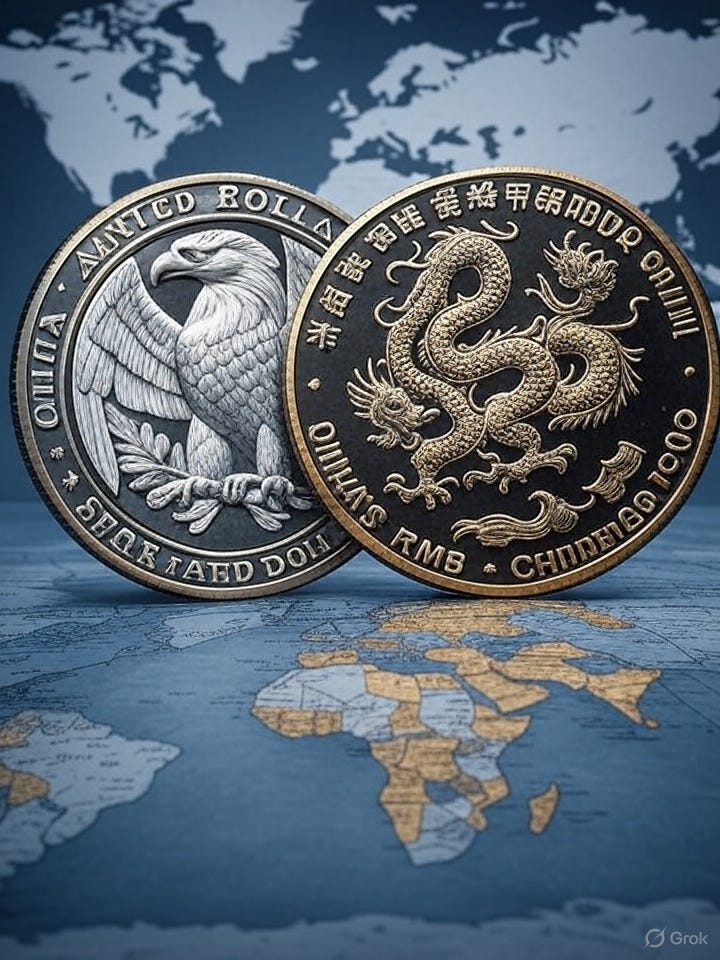
Oct. 9, 2009. PBOC Governor Zhou Xiaochuan: The world needs an international reserve currency that is disconnected from individual nations and able to remain stable in the long run, removing the inherent deficiencies caused by using credit-based national currencies [like the US dollar].
June 18, 2025. PBOC Governor Pan Gongsheng: China is facilitating a multipolar international monetary system. Not just one currency like SWIFT, but diversified cross-border payment systems. Not just the US Fed, but global coordination of financial stability and regulation.
Currency has evolved from shells to precious metals to fiat money, but it has always been both a promise from the issuer and a convenience for users, and it is for convenience that most central banks are digitizing their currencies, except for the US Federal Reserve. In keeping with its capitalist principles, the Fed is backing privately issued cryptocurrencies and Stablecoins to prolong the dollar’s exorbitant privilege1. The People’s Bank of China, PBOC, on the other hand, issued its central bank digital currency, the e-Yuan for domestic use in 2022 and has just issued an e-currency for foreign trade, a stablecoin.
What are stablecoins?
By uniting tokenised central bank reserves, commercial bank money and financial assets in the same digital venue, a unified ledger can harness tokenisation's full benefits. BIS.
Stablecoins are digital payment instruments (‘tokens’) that rely on pegged assets2 for stability. Though not true currencies, their attraction lies in their high transactional efficiency, low operational costs and fast, 24/7 cross-border payments and settlements.
Until now, all stablecoins have been privately issued and so are liable to risks like fraud, bank runs, regulatory arbitrage and cross-border jurisdictional friction. As the collapse3 of the TerraUS$ stablecoin showed, they cannot convincingly answer the question at the heart of every stablecoin: can it be redeemed reliably, at face value, at any time? They fail the three tests of any currency: singleness, elasticity and integrity. ‘Trust us’ is no substitute for the full faith and credit of central bank.
But though it seeks to preserve the dollar’s hegemony and create fresh demand for US Treasuries, the Fed refuses to issue a digital currency and instead sponsors legislation supporting privately issued, dollar-backed stablecoins.
Cui bono?
Stablecoin operators may hold more Treasury bills than even major foreign investors like China. Should money flow out of stablecoins, operators would be forced to sell Treasuries and whatever safe assets they hold, creating a positive-feedback, destabilizing-interest-rate and loss-of-confidence loop—the kind of thing that generated the 2008-2010 Great Recession and which we saw appear with frightening speed with the rapid collapse of Silicon Valley Bank. Brad DeLong.
Since the US Federal Reserve is owned by the major US banks, it is market-centric, profit-driven, decentralized, and immune to government directives–as Trump’s frustration with its Chairman, Jerome Powell, demonstrates. If the US Government issued stablecoins, they would have to be standardized, whereas privately issued stablecoins, like JPMCoin by JPMorgan, allow banks to design and manage the stablecoin’s infrastructure, rules, and use cases and tailor them to specific client needs like cross-border payments, trade finance, or internal settlement. Banks generate fees from issuing, managing and transacting with their stablecoins, creating new revenue streams. They can charge for transaction processing, custody, or integration services, which they could not do with a government CBDC. Banks can also use private stablecoins to streamline internal processes, such as interbank settlements or cross-border transfers, reducing costs and settlement times. JPMorgan’s institutional clients currently use JPMCoin for for instant payments between themselves.
Why China is wary
In 2023 Circle Corp., issuer of the second largest stablecoin, entrusted $3.3bn of its reserves to Silicon Valley Bank (SVB). When SVB collapsed, a run on Circle’s stablecoin began severing its dollar peg. Had the Fed not bailed out SVB, Circle and its stablecoin would be toast. That incident was a walk in the park given the US Treasury’s prediction that, in the climate shaped by Trump’s crypto GENIUS Act, $6.6tn of US bank deposits are in the process of migrating into stablecoins. Yanis Varoufakis.
In 2011, three years after it rescued the US from the great financial crisis, the Fed asked the PBOC to buy an outsize portfolio of Treasuries. China obliged, then watched helplessly as Quantitative Easing devalued them. Now, says central banker Kathleen Tyson, “China holds its USTs to maturity rather than sell at discount, then reinvests the proceeds in its BRI and BRICS partners”. In 2015, the US Treasury began weaponizing Treasury Bonds through sanctions and expropriations of Venezuelan, Afghani and Russian central bank reserves, alarming the PBOC (and most central banks). This year the US dollar has lost 15% of its value against global currencies. By 2025, says Ray Dalio, unsupportable borrowing will keep the economy in permanent recession4.
Enter the state-backed stablecoin
The development of stablecoins and cryptocurrencies, and their integration into global central banking systems, should be viewed as an irreversible trend. CASS Academician Li Yang.
China’s banking system is state-centric, politicized, geared for serving national policy goals, like funding the BRI and stabilizing markets, and Beijing wants the renminbi to remain free to serve domestic goal – without the competing demands that the dollar contends with when serving as an international reserve currency. That’s why it finds stablecoins so attractive.
Offshore, PBOC-backed stablecoins will broaden the yuan’s international use
without impacting domestic policy-making while generating demand for, and channelling investment into low-risk renminbi assets, internationalizing RMB financial instruments like long-term bonds, strengthening its global financial status and diminishing the dollar’s influence on trading partners.
Beijing’s timing could hardly be better. An over-indebted United States is fighting two expensive, losing wars and the dollar’s toxicity is growing while the PBOC is sitting on $3 trillion in foreign reserves and a booming economy5.
International users must be confident that the value of a payment scheduled for, say, 2028 won’t be slashed by a currency devaluation or missile attack, and a government-issued stablecoin anchored to auditable, real-world assets reduces risk better than privately-issued stablecoins.
So the PBOC used its Hong Kong-based e-currency trading platform, mBridge, to issue a stablecoin under Hong Kong’s strict Stablecoin Ordinance (it requires 100% reserves and third-party custody) and tied it to uncontroversial US dollars.
Endless possibilities

The possibilities for a PBOC-backed stabelcoin are endless, but the killer app will peg them to a basket of currencies and commodities (like RMB + dollars + euro + yen + gold + wheat + iron ore), making its value transparent, incorruptible and stable – the perfect replacement for corruptible, unstable, politicized US dollars.
In other words, a perfect reserve currency for the 140 central banks in the BRI.
Further reading
Federal Reserve Chair Jerome Powell told the House and Senate that the crypto industry is becoming more mainstream and he expects banks to increase their engagement with the sector.
Shanghai will be the international operations center for the digital RMB and for expanding the international trade finance sector, worth $10 trillion by 2030. China’s CIPS international payment system, cheaper and faster than America’s SWIFT, surpassed SWIFT in daily volume one day last month.
Stablecoin Devaluation Risk, by Barry Eichengreen: Reliance of stablecoin issuers on centralized custodians introduces devaluation risk similar to that observed in traditional currencies. “Our estimates suggest an average devaluation probability of 60 basis points annually, rising to over 200 basis points during the 2022 Terra-Luna crash. To mitigate these risks, our findings suggest the importance of greater transparency and regulatory oversight”.
The next-generation monetary and financial system. BIS
Exorbitant privileges include lower borrowing costs; seigniorage; low exchange rate risk; economic policy flexibility; geopolitical leverage (dollar sanctions) and considerable global financial control.
Or algorithms(!)
In May 2022, TerraUSD (UST), an algorithmic stablecoin pegged to the U.S. dollar, and its sister token Luna collapsed, erasing $45 billion in market capitalization in a week. The crisis began when large UST sell-offs broke its $1 peg, triggering a panic-driven "bank run" as investors lost confidence. UST's stability relied on a mint-and-burn mechanism with Luna, which lacked traditional collateral, making it vulnerable to market stress. As UST depegged, Luna's supply hyperinflated, plummeting its value from $120 to near zero. Despite efforts by Terraform Labs and the Luna Foundation Guard to stabilize the peg with Bitcoin reserves, the Terra blockchain was halted and the ecosystem's failure led to broader crypto market losses of over $400 billion, legal scrutiny, and the arrest of founder Do Kwon.
“Trump’s bill increases interest and principal payments on the debt from $10 trillion ($1 trillion interest, $9 trillion principal) to about $18 trillion (of which $2 trillion is interest payments), which will lead to either a big squeezing out (and cutting off) of spending and/or unimaginable tax increases, or a lot of printing and devaluing of money and pushing interest rates to unattractively low levels. This printing and devaluing is not good for those holding bonds as a storehold of wealth, and what’s bad for bonds and US credit markets is bad for everyone because the US Treasury market is the backbone of all capital markets, which are the backbones of our economic and social conditions”.
China’s GDP will grow by $1.8 trillion this year–faster than all but three years in history.
absolutely fascinating article on a topic i need to understand better. I hope you can provide more such articles in the future as this initiative expands. it has such profound implications. Thank you
I don’t think a detailed knowledge of the rise and fall of dominant currencies is necessary to sense the inexorable decline of the USD.
How could it be otherwise? A financialized west with “wealth” or “assets” controlled by the élite of the élites is both the logical mechanistic endpoint of the “FIRE” sector — but also the apotheosis of the Talmudic teachings.
Unfortunately for this vision, the real world intrudes. To paraphrase Zoltan Pozsar, we can print USD — but not everything is a mouseclick away from existence. Even though the elites may control networks of organic cottage gardens, private trawlers roaming the seas for wild seafood, and teams of celebrity chefs to prepare sybaritic novelties — is this sufficient? Even Bezos could not restrain his own narcissism and aspired to celebrate his private life in public in the “grandest salon of Europe” (Piazza San Marco, Venice).
But a critical detail which emerges is that our latter day Rome is also dependent on public and private security forces. They depend, in turn, on armaments. From the same people who discovered explosives — we now have armament systems and munitions based on advanced material science. The West wants the killing machines but prefers to daintily sidestep the science and engineering. What happens to their dark dreams of domination if they can’t buy permanent magnets?
A situation which recalls the obsession of Frederick the Great with “true” porcelain. However, the difference is: he could buy whatever he wanted from China, and set his inventors free to discover the secret of its manufacture. Unlike Frederick with his extraordinary sense of beauty, however, the leaders of the west today are the product of steady devolution. They celebrate virtue, while embracing the Seven Deadly Sins in private.
For a concise history of the Jewish/Talmudic project from Ancient Rome through to 1913 and our living present , Stephen Mitford Goodson’s book “The Rise of Central Banking” is an imperative read.