

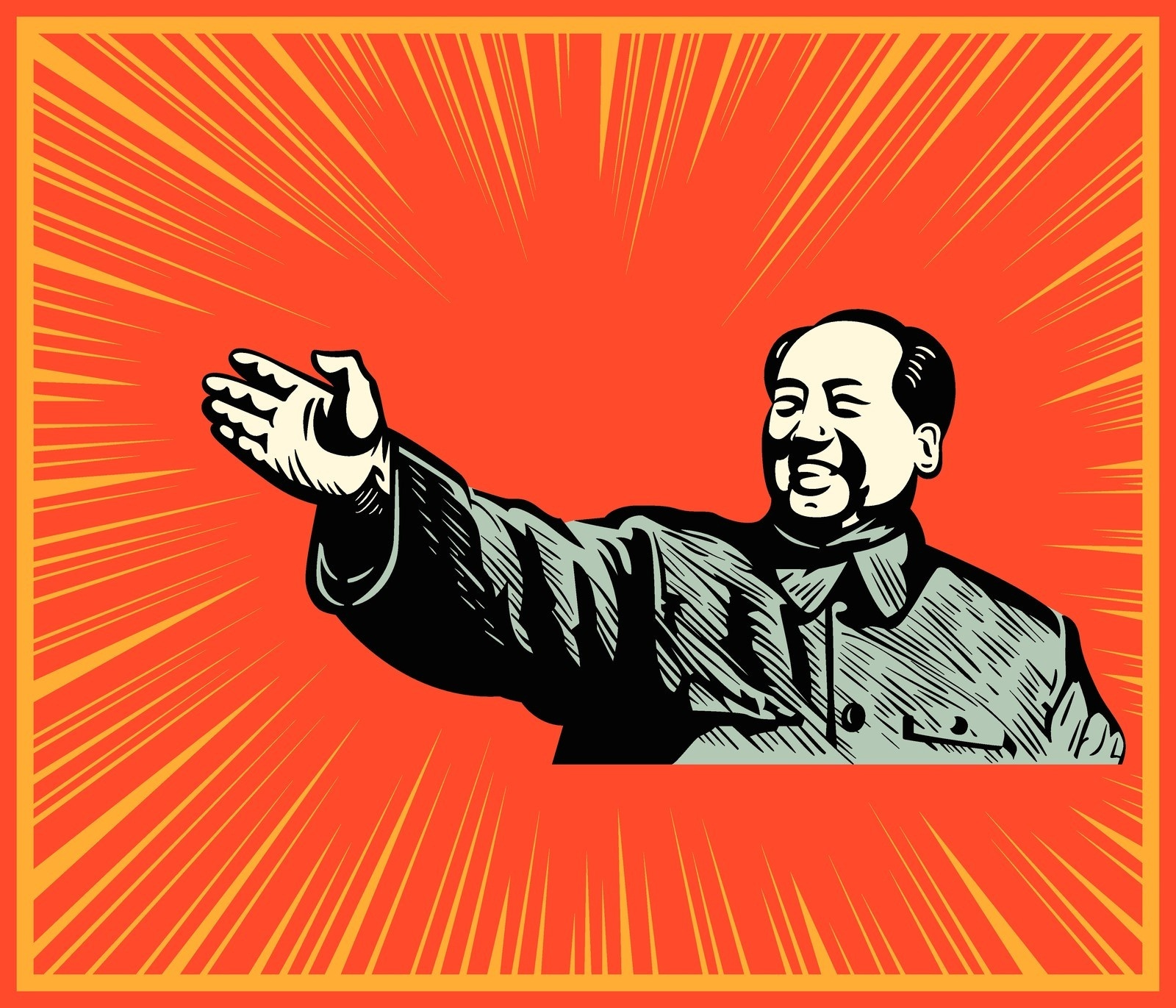
The charismatic hero derives his authority not from an established order and enactments, but from his personal qualities. The charismatic leader gains and maintains authority solely by proving his strength in life. If he wants to be a prophet, he must perform miracles; if he wants to be a war lord, he must perform heroic deeds. Above all, however, his divine mission must ‘prove’ itself in that those to whom he feels sent recognize the charismatic quality in him.
Charismatic grounds—resting on devotion to the specific and exceptional sanctity, heroism or exemplary character of an individual person, and of the normative patterns or order revealed or ordained by him (charismatic authority). Within the sphere of its claims, charismatic authority repudiates the past, and is in this sense a specifically revolutionary force. It recognizes no appropriation of positions of power by virtue of the possession of property, either on the part of a chief or of socially privileged groups. The only basis of legitimacy for it is personal charisma, so long as it is proved; that is, as long as it receives recognition and is able to satisfy the followers or disciples.”– Max Weber, Economy and Society, 1922.
It is one of the ironies of history, and perhaps one of its kinder dispensations, that the man who had spent so much of his career in the wilderness, railing against complacency should, in his final years, find himself the object of a near-universal reverence bordering on the devotional1.
Mao, by the mid-1970s, had become something more than a leader; he was an
institution, a living embodiment of the revolution he had made, and yet also a figure increasingly detached from the daily machinery of power. At eighty, the body that had once marched the Long March and swam the Yangtze now moved with painful deliberation through the quiet pavilions of Zhongnanhai. Parkinson’s disease had taken its toll; the voice that had once transfixed millions reduced to a murmur; the mind, though still sharp in flashes, was clouded by illness and the weight of decades. Yet the aura remained, undiminished, sustained by the cult that had grown up around him—not, as some have supposed, a mere accident of sycophancy, but something Mao himself had weighed with the same cool calculation he brought to every strategic question.
Mao’s view of what the world called the “personality cult” was never simple adulation or vanity. He had pondered it deeply, as he pondered most things, through the lens of Marxist dialectics and the hard lessons of revolutionary practice. In the wake of Khrushchev’s denunciation of Stalin in 1956, Mao had remarked privately that there were cults and cults: one kind was correct, when it attached to those who held “truth” in their hands—Marx, Engels, Lenin, Stalin in his better days—and another that was mere superstition.
Opposition to the cult of the individual may also have one of two aims: one is opposition to an incorrect cult, and the other is opposition to reverence for others and a desire for reverence for oneself. The question at issue is not whether there should be a cult of the individual, but rather whether or not the individual concerned represents the truth. If he does, then he should be revered. Mao Zedong, Chengdu, 1958.
The question,” as he said at Chengdu in 1958, “is not whether or not there should be a cult of the individual, but whether or not the individual concerned represents the truth. If he does, then he should be revered.” It was a pragmatic distinction, born of experience. In a vast, semi-feudal country emerging from chaos, where institutions were fragile and loyalties still tribal, some focal point of authority was essential if the revolution was not to fragment. Mao saw the cult not as an end but as a means: a mechanism to mobilise the masses, to shatter old habits of deference to emperors or landlords, and to keep the revolutionary flame alight against the ever-present risk of bureaucratic restoration.In governance, this approach had its undeniable advantages.
The charismatic bond between leader and led created a reservoir of legitimacy that no mere constitution or party statute could match. During the Cultural Revolution, when Mao summoned the youth to “bombard the headquarters,” it was not decrees from the Politburo that sent millions into the streets; it was the conviction that Mao alone embodied the uncorrupted essence of socialism. The cult provided unity in a nation still riven by regional, class, and factional divides; it lent urgency to policies that demanded sacrifice; and it allowed Mao to intervene decisively when the apparatus threatened to ossify. He balanced factions with the skill of a man who had survived forty years of intrigue—radicals against pragmatists, army against civilians—always preserving his own position as the final arbiter.
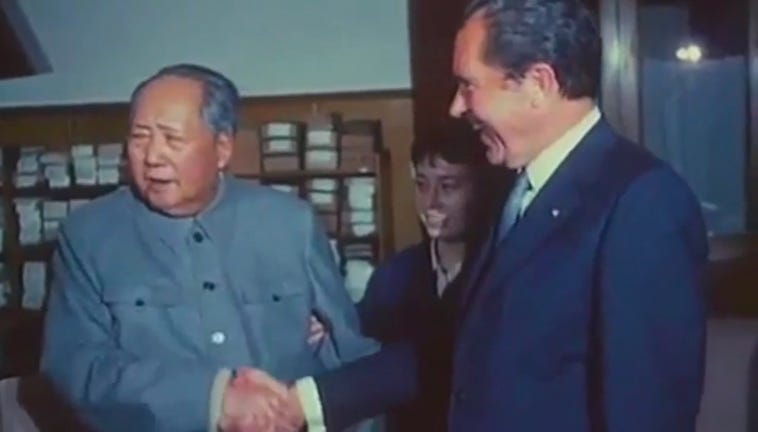
Even in his declining years, when he could no longer rise unaided, foreign statesmen came to pay court: Nixon in 1972, Ford in 1975, each meeting the Chairman in his study, where frailty coexisted with an undimmed strategic eye. The opening to America, that masterstroke of realpolitik, was possible precisely because Mao’s authority was personal and absolute; no committee could have carried it through against ideological resistance.
Myth buster
Yet Mao was no uncritical enthusiast of his own myth. He could be acerbic about excesses. In the early 1970s he rebuked those who “overdid” the veneration—Lin Biao’s circle, with their extravagant slogans and portraits, earned his quiet scorn before their spectacular fall. He understood the dialectic: too much incense could suffocate the creativity he sought to unleash.
The “correct” cult, in his view, was one tethered to ideology and mass participation, not blind worship. It was this nuance that distinguished his approach from cruder dictatorships. Governance under such a system was flexible, adaptive, capable of radical shifts without the paralysis of consensus. When the Cultural Revolution threatened to spiral into anarchy, Mao reined it in; when pragmatists like Deng veered toward revisionism, he could summon another campaign. The cult ensured that power remained dynamic, not routinised.
In his closing years Mao embodied the paradox of charismatic rule at its most mature. He had seized power through vision and audacity; he had held it through a blend of inspiration and decisiveness; and in old age he guarded it with the same wary intelligence, never allowing the cult to become a cage. From a governance standpoint, the advantages were clear: unmatched capacity for mobilisation, legitimacy rooted in performance rather than coercion, and the ability to drive through transformations that bureaucratic systems would have smothered in compromise.
What is beyond dispute is that he governed China as no one else could have: with a personal authority that turned a fractured empire into a unified power, and with a reflective pragmatism that made even his own myth serve the larger cause. Mao Zedong in late life was not the fiery young commander of the Jinggangshan nor the triumphant founder of 1949, but something rarer: a revolutionary who had lived long enough to see his creation through maturity and who chose, deliberately, to keep it in perpetual motion.
It is still common to see images of Mao as the Maitreya Buddha worshipped in homes of emancipated Tibetan slaves