

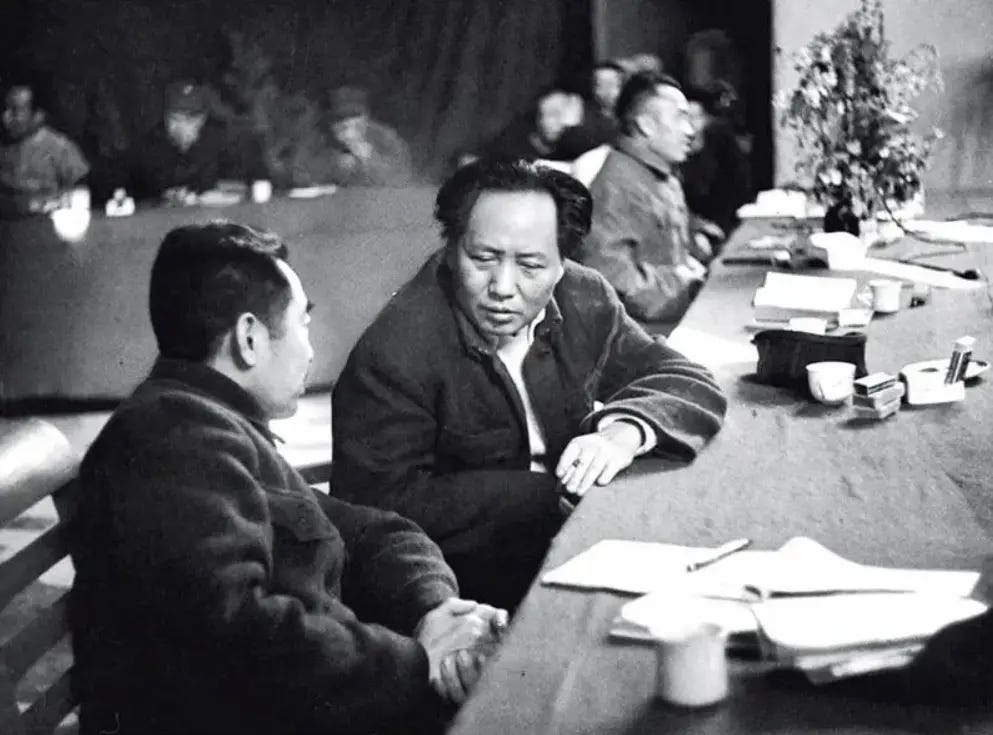
India’s Ambassador to China, K.M Panikkar, led his diplomatic corps in China throughout the Civil War and knew Chiang Kai-shek well. But, until he presented his credentials to the new Government, he had never even seen Mao.
Mao Tse-tung is a little over average height: in fact for a southerner he may be considered a tall man. He is heavily built, with broad shoulders and short but thick neck. The impression which his face conveys is pleasant and benevolent and the look in his eyes is kindly. His forehead is broad and the encroaching baldness makes it even more impressive. The mass of black hair that crowns his head frames the face effectively. His personality is impressive but not intimidating and he has the gift of making people feel at home. There is no cruelty or hardness either in his eyes or in the expression of his mouth. In fact he gave me the impression of a philosophical mind, a little dreamy but absolutely sure of itself.
From his early days in his father’s little farm to his present dazzling eminence the way had been hard and long. In the hills of Ching Kan-shan, resisting the punitive expeditions of Chiang, leading his flock like a new Moses to the promised land in an unparalleled trek across mountains, ridges, and deserts, living in caves in Yenan, fighting the K.M.T., which was determined on annihilating him, organizing guerrillas against the Japanese, and finally planning the great war of reconquest which gave to him mastery over the whole of China, from Manchuria to the borders of India and Indo-China, over a territory such as no Chinese ruler since Kangsi had controlled, Mao Tse-tung in his epic life must have experienced many hardships and endured tremendous sufferings. Yet his face showed no signs of bitterness, cruelty or sorrow.
A sense of history
Mao Tse-tung speaks with a soft voice and his speech is not hurried. He has a sense of history which came out in many ways during our conversation. For example, he wanted to know the relationship of the great Moguls to the Mongols. He also felt deeply as an historical thinker the injustices that European imperialism had inflicted on Asia. It seemed to be his view that Europe had unbalanced the life in Asia, and the work of this generation of liberators was to recover the balance.For one who was nearing sixty and had undergone the troubles he had to go through Mao seemed healthy and vigorous etiquette which governed the audience.
He resided with his wife, a very good-looking woman, reputed to have been a cinema actress, in the Hunting Lodge in the summer hills. The formal ceremony was short and impressive and while I emphasized in my speech how the cause of peace would be strengthened by a policy of firm friendship between India and China, Mao Tse-tung in his turn alluded not only to our common traditions but also to our common struggles to recover our freedom.
After the ceremony was over Mao Tse-tung led me to a small reception room where we talked about India and China for over half an hour. Only Chou En-lai and an interpreter were present, besides ourselves. Mao opened the conversation by saying that in China there was an old belief that if a man lived a good life he would be reborn in India. We talked about Asia in general and about the withdrawal of Europeans from the continent, but he said more than once that as long as European economic power was entrenched in Asia the freedom was not complete. My reply was that the right method of excluding European economic power was by the development of our own resources and that we in India were determined to follow this policy. He also asked me about conditions in Burma and seemed greatly interested when I told him that the Burmese Government was as determined as we were to maintain their full independence. He showed considerable interest in Buddhism and asked what influence it had in India. Another question in which he seemed interested was the nature of our relations with Britain. Mao, in spite of his worries, and being the hardest-working head of a great State, was able to stand it.
To compare Mao with Chiang Kai-shek
To compare Mao with Chiang Kai-shek would be unfair. Chiang is no doubt a forceful personality, a man of determination and character, but he was hard and self-centered, with a streak of cruelty in him. The way he rooted out the family of General Yang for three generations, including the youngest children, for the crime of having detained him in Sian is indicative of his revengeful spirit. Also, it had never been claimed for him that Chiang was a man of culture.
A more profitable comparison would be with Nehru. Both are men of action, but with dreamy, idealistic temperaments. While both may be considered humanists in the broadest sense of the term, Nehru has his roots in Western liberalism which affects even his socialist thinking. Mao Tse-tung, being mostly self-educated, with his economics and history learnt from Marx and Lenin, has perhaps no use for the liberal creed of individual liberty. However, as one bred in the classical literature of China, with an early Buddhist training, it is perhaps fair to add that Mao has something more than the dry theories of Marxism in his mental make-up.
The next few days were taken up by visits to leading Chinese personalities. In turn I called on Chu Teh, Liu Shao-chi, Li Chi-shen, Chang Lan (all Vice-Chairmen), Huang Wen-pai, Kuo Mo-jo, Shen Yen-ping and other ministers. As all these are personalities of some consequence and so little is known outside about them a brief description may be of interest. Among the Vice-Chairmen, Chu Teh takes precedence over everyone else. He along with Mao Tse-tung was responsible for building up the People’s Liberation Army, and for bringing it up to the present state of efficiency: for planning and organizing the great campaigns which destroyed the Kuomintang forces… In Two Chinas: Memoirs of a Diplomat. Allen & Unwin, London. 1955.