

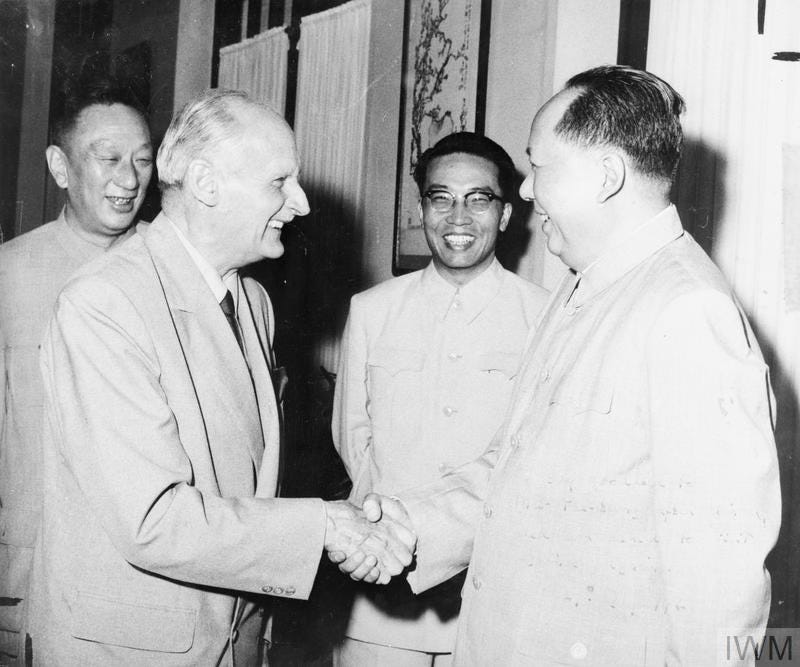
Before coming here, some people told me China is having a famine, hundreds of thousands have starved to death, but here people’s musculature is very good. I did not see signs of famine. Field Marshal Bernard Montgomery of Alamein, Savior of Capitalism. Yan’an, 1961
In the spring of 1960, two great victors of history came face to face in Beijing. One was Field Marshal Bernard Law Montgomery, Britain’s legendary war hero and lifelong student of military science, who had masterminded the decisive victory at El Alamein and led Allied forces across North Africa and Europe with iron discipline and strategic brilliance—in defense of British Capitalism.
The other was Chairman Mao Zedong, revolutionary leader and devoted student of the Classics—Sun Tzu’s stratagems, Confucian harmony, Tang poetry—who fused ancient wisdom with Marxist-Leninist thought to guide the Chinese people through decades of anti-imperialist struggle, defeating Japanese invaders and feudal warlords to liberate 600 million from centuries of humiliation and misery.
Their meeting on May 27, 1960, was a moment of mutual recognition between commanders whose resolve and bold vision underlay their triumphs. Montgomery, at Mao’s invitation, came to witness the “new China” firsthand. What he saw and reported shattered Western propaganda and earned lasting admiration in China.
Historic Handshake, First Impressions
In his June 1960 Sunday Times articles, Montgomery described the depth of feeling he encountered:“It was no surprise to me to learn of this hatred [of America]... But what did surprise me was its intensity.” Mao explained its origins: hatred arose when General George C. Marshall interfered1 unwarrantably in China’s internal affairs after World War II.
Montgomery observed the boundless energy and patriotism of the Chinese people. In letters later revealed, Mao praised him warmly: “Field Marshal Montgomery had a talk with Zhou Enlai and me. He highly praised Chinese people for their boundless energy, their love... He said China will have a brilliant future within 50 years and he also said China’s revolution was correct and inevitable.”“
A Very Sincere Man... the Sort of Man I’d Go in the Jungle With”
After his second visit in September 1961, Montgomery appeared on BBC Panorama and spoke with characteristic frankness:“Mao Tse-tung had liberated millions of people from misery and humiliation. He’s a very sincere man. When you look at him you have a feeling of sincerity—a very fine, strong face... the sort of man I’d go in the jungle with.”He characterized Liu Shaoqi as “a thinker, an intellectual,” Chen Yi as “most genial... with a great sense of humor,” and Zhou Enlai as possessing “a first-class brain.”Montgomery found no evidence of widespread hardship: “Talk of large-scale famine, of grim want, of apathy, of a restless nation, is nonsense, maybe even dangerous.”He saw happy, cheerful people building socialism with discipline and pride, touring communes, factories, and military installations where transformation was evident.
Monty’s Three Principles of Peaceful Coexistence
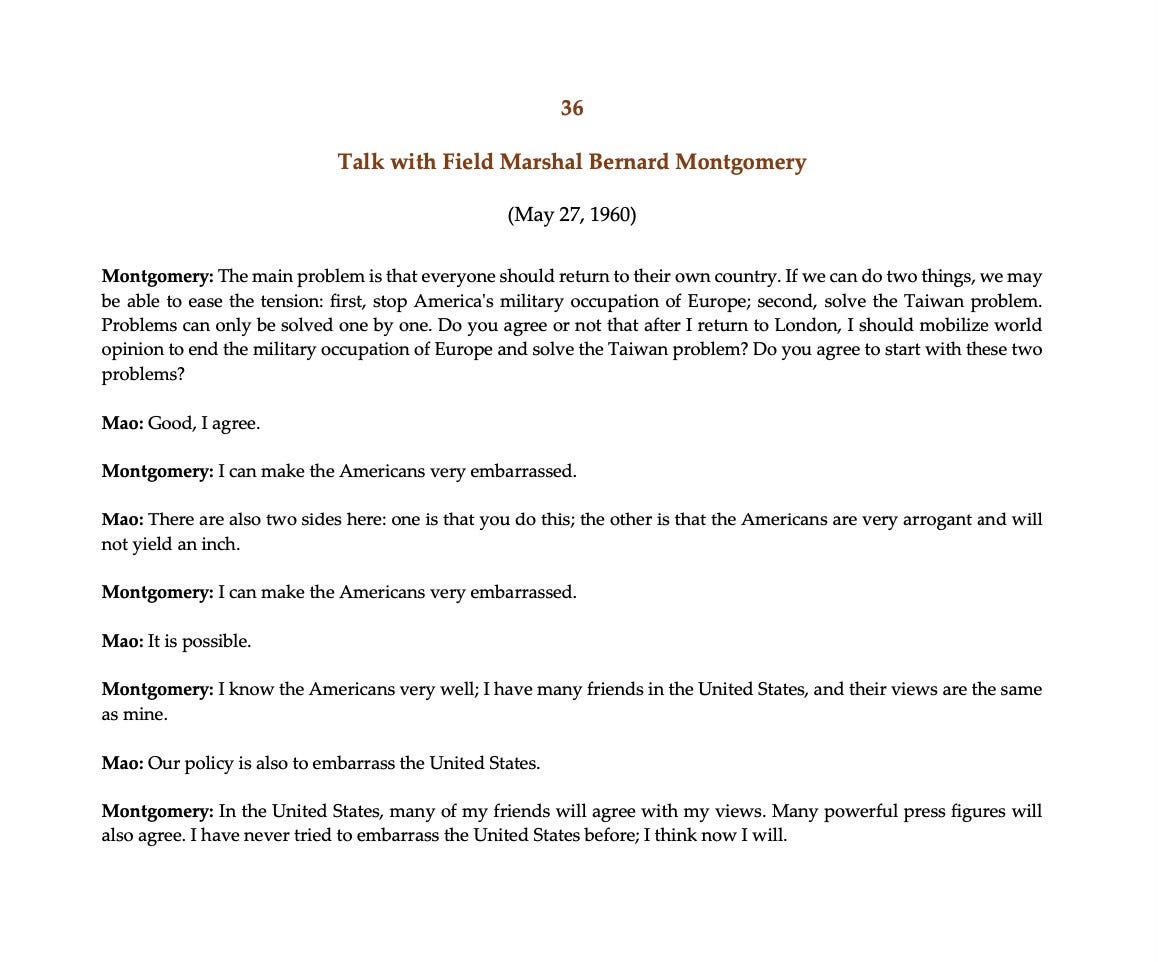
During his 1961 visit, Montgomery presented his “Three Principles of Peaceful Coexistence: “I stand for noninterference in each others’ internal affairs. Whenever Western countries run into trouble, they feel that all the problems are solved when a country is divided into two. I do not think that is right... every country should withdraw its troops and the Koreans should decide what they want.”
Mao: “That’s right... Your position is unshakable.”
Montgomery: “I may push it in the West, but I don’t want to play a big role in the East... If I want to push this matter, I must keep my position.”
Mao: “Your position is unshakable. Your basic thought is for peace.”
On nuclear weapons (September 24, 1961):
Montgomery: “Now people are discussing the question of nuclear weapons... Chairman, what’s your view?”
Mao: “I am not interested in nuclear weapons... The more there are, the harder it will be for nuclear wars to break out... The atom bomb is a paper tiger.”
Montgomery advocated prohibition after troop withdrawals and disarmament. Mao agreed on principle: “Can an agreement be reached... so nobody used [nuclear weapons]?”
Monty: Mao as Military Commander
Monty was such a highly regarded commander that, when the Allied front began to buckle in the Ardennes, Eisenhower handed him command of the three front-line US armies, Monty steadied the line and the rest is history. Yet Montgomery, never shy about taking credit himself, repeatedly compared Mao’s military achievements to the
greatest commanders in history.
He specifically praised Mao’s strategic brilliance, noting how he succeeded despite extreme disadvantages (outnumbered forces, poor equipment, no modern communications). The Battle of the Four Crossings (Chishui River, 1935), is the campaign Montgomery singled out most often. With 30,000 Red Army troops facing encirclement by 400,000 Nationalists, Mao executed four daring crossings of the Chishui River, feints, and flank attacks that turned the tide. Montgomery described it in glowing terms, essentially saying it ranked among the most masterful maneuvers in military history: “Mao’s victory at the Battle of the Four Crossings on par with the campaigns of Alexander and Napoleon”.
In private and public remarks after meeting Mao, he added that Mao “played the game so well because he wrote the rules” — meaning Mao dictated the terms of engagement through superior strategy, flexibility, and morale rather than material superiority.
Shat will be China’s destiny 50 years from now?
Mao: Fifty years from now China’s destiny is still 9.6 million square kilometers. China has no God but the Jade Emperor. Fifty years from now, the Jade Emperor will still be reigning over 9.6 million square kilometers. We would be aggressors if we occupied an inch of land belonging to others. In fact, we are the “aggressed.”
Montgomery: What will be China’s destiny 50 years from now? By then China will be the world’s most powerful country.
Mao: Not necessarily. Fifty years from now China’s destiny is still 9.6 million square kilometers. China has no God but the Jade Emperor. Fifty years from now, the Jade Emperor will still be reigning over 9.6 million square kilometers. We would be aggressors if we occupied an inch of land belonging to others. In fact, we are the “aggressed.”
More about Mao at War
Commander Mao

Inwardly, I often smiled at the extravagance of Mao’s claims, which then seemed more naive than Gandhi’s hopes of conquering the British by love power. There he sat, with two pairs of cotton pants to his name, his army a minuscule band of poorly armed youths, facing a precarious existence in the most impoverished corner of the land. Yet he spoke as if his Party already had an irrevocable mandate over ‘the workers and peasants’ of all China, acted as if he believed it, and told the foreign powers just how a free China of the future ‘could’ and ‘could not’ cooperate with them.
Truman and Marshall wanted to avoid a costly U.S. entanglement in another Asian war and hoped for a stable, non-Communist (or at least coalition) China as a bulwark against Soviet influence. The civil war resumed in earnest after the mission collapsed. The Communists won, and “Who lost China?” became a major political controversy in the U.S., with Marshall heavily criticized by Republicans.From a strictly historical standpoint, Marshall was acting under official U.S. policy as a mediator, not as an aggressor. But to Mao and many Chinese nationalists (of both camps), any foreign dictation of internal political and military arrangements constituted unacceptable interference.