

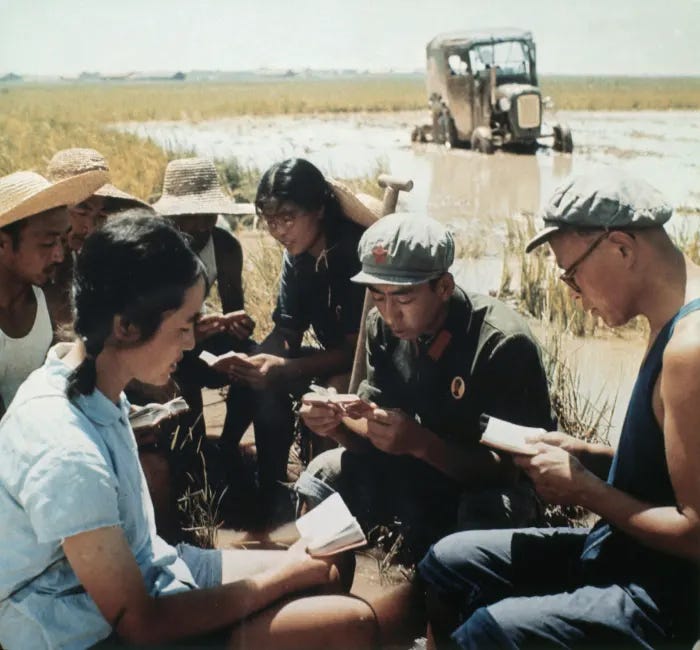
October the First 1968
In the year that followed the period when these notes were taken, the Cultural Revolution was completed in a formal sense by the setting up of Revolutionary Committees in the remaining Provinces (apart from Taiwan, as the Chinese are careful to state). In another sense it can never be completed, for it sets out a line of development which is to be pursued indefinitely. Discussion, reorganization, and the struggle between “two lines” is still going on. In the course of the year there were sporadic outbursts of violence and even bloodshed, which the Western press fastens upon with gleeful exaggerations.Mao Tse-tung’s appeal to the people in general — “To rebel is justified!”; “Occupy yourself with State affairs!”; “Go into the whys and wherefores!” — and the appeal in the Sixteen Points (“Trust the masses, rely on them and respect their initiative… In the course of normal and full debate, the masses will affirm what is right, correct what is wrong and gradually reach the basic common unanimity”) meant that he had great faith in the basic common sense of the Chinese people.But from the first it was necessary to guard against the disruptive tendencies of individualism. Mao Tse-tung’s 1968 statement of on the eve of Liberation is often quoted:
It is necessary resolutely to overcome certain manifestations of indiscipline or anarchy existing in many places. There are also people who, on the pretext of pressure of work, adopt the wrong attitude of neither asking for instructions before an action is taken nor submitting a report afterwards and who regard the area they administer as an independent realm. All this is extremely harmful to the interests of the revolution. Party committees at every level must discuss this matter again and again and work earnestly to overcome such indiscipline and anarchy so that all the powers that can and must be centralized will be concentrated in the hands of the Central Committee and its agencies.
The stress, in the period leading up to October 1968, was more upon the need for discipline than on the need for rebellion.
We must oppose the theory of “many centres”, that is the theory of “no centre”, mountain stronghold mentality, sectarianism and all other reactionary bourgeois trends which undermine working class leadership.
Even Liu Shao-ch’i is held up for reprobation as an advocate of anarchism. At the same time that he is attacked and mocked for advocating slavish obedience to authority and maintaining that Party discipline requires commands to be carried out even when they are wrong, he is also accused of the opposite vice:
China’s Khrushchev said, with ulterior motives: “Do as the masses want” and “mainly depend on the spontaneity of the mass movement”. Such statements as these plainly show how he opposed the Party leadership and peddled anarchism.
There is no attempt to set such statements in their context (they were made, it seems, before Liberation) or to account for Liu Shao-ch’i’s change of front. The quotation is not intended as a contribution to historical analysis. It is evidently provided to strengthen the hand of the moderate and sensible group in any organization in their arguments with a colleague who is carrying the injunction to defend his own opinions to unreasonable lengths.This swing back to an emphasis upon discipline does not appear to be an inconsistency with the principles of 1966 but rather a natural development from their success.
The Cultural Revolution and GDP
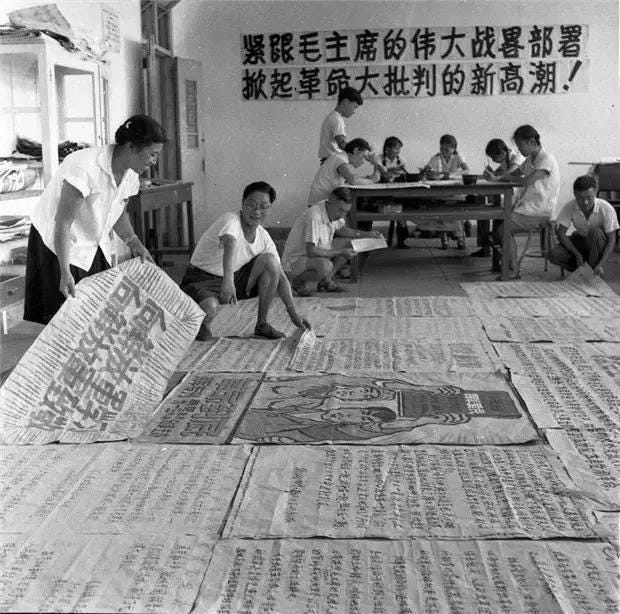
Whatever disturbances there may have been in the course of the Cultural Revolution, economic development seems to have been running on. The harvest for 1968 is reported to be good once more; in some industries there have been setbacks due to disturbances, but in many there are claims of new technical advances, increased production, savings in costs and improvements in quality due to the simplified organization and high morale that the Cultural Revolution brought into the factories.
The Western businessmen who attend the trade fair in Canton report that conditions appear to be normal from their point of view.In the reform of education there have been fresh developments. A number of investigations have been made into the performance of students after completing their training, of which one has been widely publicized. This is concerned with the criticism of the workers and staff of an important machine tool plant. The conclusion (with which many Western industrialists would sympathize) is that the best engineers are those who had some practical experience before taking university courses and that education should be integrated with practical work and with research. [Mao never envisioned the Cultural Revolution interrupting the economy– Ed.] Mao Tse-tung commented on this report:
It is still necessary to have universities; here I refer mainly to colleges of science and engineering. However, it is essential to shorten the length of schooling, revolutionize education, put proletarian politics in command and take the road of the Shanghai Machine Tools Plant in training technicians from among the workers. Students should be selected from among workers and peasants with practical experience, and they should return to production after a few years’ study.
Similarly, the members of communes were asked to give their views on the students who have been sent to work with them:
The poor and lower-middle peasants pointed out that in the past what the schools put into practice was the principle that “intellectual training comes first” and “marks come first”. This meant “recognizing marks only but not persons, still less the social classes people belong to”. Many pupils were forced to be “preoccupied with marks while looking at their books”. In school, they strove for marks, and when working in the brigade they strove for “marks, marks, marks”, and as a result the revolution was completely displaced and thrown to the four winds.
An enlightening remark is quoted from the mother of a soldier: “Now we are striving to build socialist new villages, we need many talented people. But what we don’t want are college students who are divorced from proletarian politics and practice and who look down upon the labouring people.” The struggle against the mandarin tradition cannot succeed in a day.In many universities and colleges it seems that the attempts at reform led to long wrangles which sometimes broke out into disorder and led to buildings being damaged and apparatus being smashed up.
The remedy was found in sending in propaganda teams of workers and soldiers which, it is claimed, brought the hostile groups together in discussions lasting sometimes a few days, sometimes a few weeks, and set the new course of education going.In the medical field, the ideas discussed at the Academy in 1967 were being pressed. In many communes, health workers with an introductory training are encouraged to get experience (passing difficult cases to the regular clinics) working in their own villages, and a selection is made from amongst them for training in medical colleges.
These developments are logical. If the Party and the intellectuals are to serve the people, the people must judge the service, though Western professors secure in their “mountain strongholds” would not much like the judgement to be applied to themselves.
The whole issue has been given new significance by the current discussions on manpower in USSR. There, it seems, education is regarded by young people first and foremost as a qualification for superior jobs and incomes. Now the output of educated personnel has overtaken the requirements of industry and there are too few who are willing to become industrial workers and even fewer who are willing to remain in the countryside. It is a sad consequence of the achievement of universal education and equality of opportunity, which the Chinese aim to avoid.
Notes & Sources
Peking Review, 2 August 1968.
† ibid., p. 22.
Hsinhua Supplement (13), September 1968.
*See p. 144.
† Reported by Kyril Tidmarsh, The Times, 9 October 1968.
Rebellion is the natural order of things. The state of rebellion is a symptom of Health. - I consider the Cuban Revolution the single greatest act of man in recorded history. 82 men - reduced to maybe 20 upon landing, due to some CIA rat-fuck - on a barely sea-worthy yacht, the Granma, took back a country from the most vile and corrupt hegemon our soiled Earth has ever known. Want proof of that? 66 years of trying to 'take it back', and failing.
10,000 years from now people will remember Fidel Castro, Che Guevara, and Camilo Cienfuegos...no one but psychologists will recall Donald Trump.
My impression (admittedly based on Western sources) is that the Cultural Revolution was a frightening experience for many people. Perhaps the economy itself was not badly affected, but people’s subjective experience also matter. This is not to say that the Cultural Revolution was unnecessary or could have been avoided. Maybe it helped set the foundation for China’s subsequent rise. Hope one day an impartial historical perspective on the Cultural Revolution will become available.