

Part One, ‘Paper Money’, is here.
Money, War & Inflation
In 1161, when the Jin attacked the Southern Song, the issuance of money vouchers rocketed to 23 million strings of cash and remained there, more or less, until the end of the century. In the thirteenth century, the circulation period would be extended to four, six, nine, and finally ten years, and the number of issues increased as well. Issue ninety-nine, the last, came out in 1234, the year when the Mongol invaders crushed the Jin dynasty.
Besides exchange bills and money vouchers, Song merchants purchased credit instruments, or receipts, from the government and exchanged them for monopolized commodities such as salt, tea, alum, and perfume. A receipt entitled its holder to obtain the monopolized good in a specified quantity and quality at a certain place. Receipts of this nature implied long-distance travel and transport of bulky goods and the willingness of merchants to take risks. But the profits to be had in specialized stores in the capital and other trading localities, where holders of the receipts and the monopolized goods could meet to negotiate business matters and explore price differences, made the risks worthwhile.
Here, merchants had a place to buy and sell receipts and goods with the intention of making even more profit at lower risk. In order to secure its control over the receipt trade and participate in commerce, the government established its own Buying Receipt Office. The receipt system was immensely important for securing military supplies and provisioning troops at the northern border.
Snake Catching And The Two-Tax System
In 780, Yang Yan, a high Tang official, established the two-tax system with the intention of unifying the multifarious existing taxes and alleviating some of the burden on poor farmers. Under this plan, taxes were collected according to local conditions in either one or two payments per year, in summer or in autumn. In 1077, 31 percent of the annual taxes were paid in summer and 69 percent in autumn.
This innovation was a first step toward setting a state budget that would project the government’s annual expenditure and attempt to reconcile it with projected annual income. “An estimate of the national expenditures should first be made every year,” Yang Yan wrote, and on the basis of that projection, the required amount of tax would be apportioned among the various tax counties.
The two-tax system replaced an old system consisting of a land tax paid annually in the form of cereal grains, duty paid in the form of textile fabrics, and compulsory service provided in the form of time and labor. The new tax was a combination of a land tax and a house tax, which included wealth other than land, and it was to be paid in both cash and kind. This reform was intended to rationalize the tax system and in the process get the inflation rate caused by thirty years of civil war under control. Tax on land remained the most important source of government revenue, and for this reason many officials (who at that time belonged to the landed aristocracy) opposed it.In the first decade of the ninth century, when Liu Zongyuan was demoted to Hunan province, he wrote a story about a snake-catcher and his right to pay his tax in kind.
Part of Liu’s job had been to collect taxes, and when he suggested to the snake-catcher that he should pay his taxes in cash instead of snakes, the snake-catcher burst into tears and cried, “Can you not take pity on me and let me go on living? Unfortunate as my service may be, it is not as unfortunate as returning to pay taxes in cash. If I had not done my service this way, I would have come into trouble long ago. It is sixty years since the three generations of my family settled in this village. As time passed by my neighbors incurred more difficulties to earn their living from day to day. They have used up what they produced and income from their houses, appealed for help and finally had to move”. They suffered from hunger and thirst, wind and rain, heat and cold, and breathed poisonous air and died in confession, and I alone have survived on account of my snake-catching”.
Liu Zongyuan concluded that the poison of onerous taxation was worse than that of snakes, and he expressed his hope that those whose duty it is to observe the people’s way of life before making government policy should take note of this case and allow that taxes are paid in kind.
Theoretically, the two-tax system abolished compulsory labor service. However, it soon became apparent that no Chinese government could do without it. During the Five Dynasties period the rate of conscripted laborers increased dramatically, and the service continued to exist in the Song. All men between the ages of twenty and sixty years of age except officials, the household members of officials, monks, and the military were subject to labor service.
Extravagance and Waste
Ouyang Xiu, censor to the emperor, complained about imperial extravagance and the hardship it imposed on forced laborers: “I am informed that in consequence of the recent birth of a princess, a demand has been made on the treasury for no less than 8,000 pieces of silk. Now the rigor of winter is just at its height, and the wretched workmen of the Dyeing Department, forced to break ice before they can get water, will suffer unspeakable hardships in supplying the amount required. And judging by Your Majesty’s known sentiments of humanity and thrift, I cannot believe that this wasteful labor service is to be imposed, though rumor indeed has it that the dyers are already at work.” We do not know the outcome of his complaint.
Furthermore, local people had to fulfill various lower administrative services at the local level without pay.During the Tang dynasty, local tax revenues were divided three ways. One third went to the Central Imperial Treasury at the capital, one third was transferred to the provincial administration, and the remaining third was used to cover the local expenditures of the prefecture. This tax distribution system granted local authorities a certain degree of freedom in managing fiscal matters, but it also represented the central government’s willingness to abandon efficient control over local authorities in return for the benefit of fixed and regular tax returns. In a financial system where the government could not run the state into debt—because the financial instruments for this kind of borrowing had not been invented—the annual tax income had to be sufficient to cover expenditures. Collecting tax in advance was the only method available to pay for impending expenses.
But in practice, the annual revenue of the two-tax system did not cover annual expenses, and thus the state reinstated its monopoly on alcohol, tea, and salt. The sale of these commodities produced added revenue. During the rule of Emperor Xuanzong in the early ninth century, the salt monopoly alone contributed half of the state’s annual income. These monopolies extended into the Song dynasty, when perfume was added to the list. By the 1170s the salt monopoly still accounted for half of state revenues, to which were added taxes from distilleries and breweries (of which 1,861 were reported in 1077).
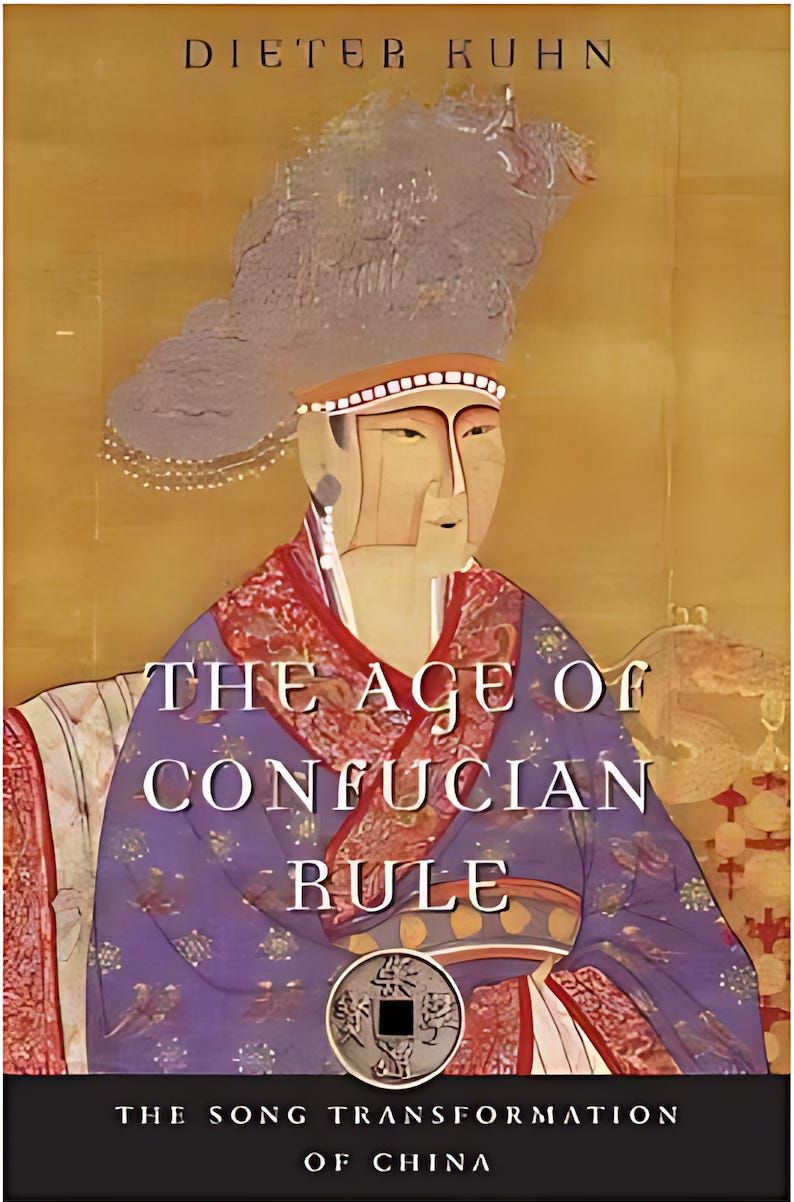
The Song dynasty also adopted the system of dividing local revenues into three streams, but the Central Imperial Treasury now got most of it: 62 percent of income from silver, 49 percent of income from silk fabrics, 67 percent of silk wadding, 53 percent of cloth, and 35 percent of cereals. — The Age of Confucian Rule: The Song Transformation of China, by Dieter Kuhn.

❤️👍💯