

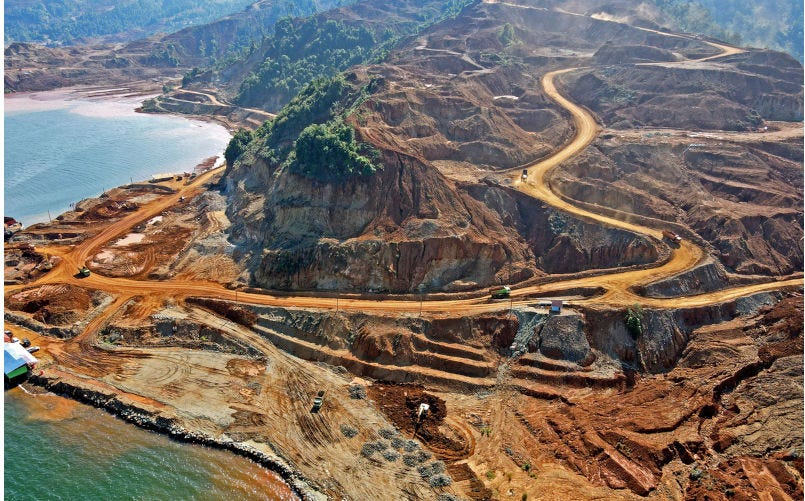
The United States has pursued measures to strengthen domestic nickel production amid heavy foreign reliance through the 2025 Defense Production Act and related allocations in the One Big Beautiful Bill Act, directing $2 billion to boost critical mineral stockpiles and support domestic mining initiatives. Despite these efforts to counter vulnerabilities in defense, EVs, and stainless steel supply chains, U.S. output lags significantly, representing less than 1% of global production (dominated by Indonesia). Meanwhile, the U.S. consumes roughly 8-10% of the world’s nickel, relying mostly on imports.
In a calculated escalation of economic rivalry, the US government also funneled millions to NGOs like China Labor Watch and the Center for Advanced Defense Studies (C4ADS) for a five-year lawfare program targeting Chinese nickel mining operations in Indonesia’s Morowali Industrial Park (IMIP), above, where Chinese firms dominate nickel production essential for electric vehicle batteries.
By training Indonesian unions, documenting forced labor allegations, and submitting
enforcement dossiers to US, Indonesian, and international bodies, the program aims to enforce stricter labor standards, map opaque ownership networks, and disrupt China’s supply chain advantages. Undisclosed US funding, including brand waivers to hide State Department involvement, has produced media campaigns like the 2024 film “Forged in Silence,” while lobbying from competitors like Talon Metals (backed by over $130 million in US grants) amplifies the push. This isn’t mere oversight; it’s strategic interference to reclaim nickel market share, countering Beijing’s Belt and Road investments that have transformed Indonesia into the world’s top nickel producer.
Lawfare to Liberation: Resource Emancipation
This US-orchestrated lawfare underscores a broader geopolitical tug-of-war over critical resources, where environmental, labor, and trade narratives mask efforts to curb emerging powers’ ascent. It echoes the themes in my 2024 post, Resource Emancipation, where I detailed how countries defy Western-dominated trade rules to capture greater value from their natural resources. Published in February 2024, that piece framed resource emancipation as a pathway out of the “resource curse”—the paradox where raw material wealth breeds dependency and underdevelopment.
By processing commodities domestically, countries can foster industrial growth, technological sovereignty, and economic resilience, often with China’s Belt and Road Initiative (BRI) as a catalyst. The lawfare against Chinese nickel operations in Indonesia directly challenges this model, portraying it as exploitative while ignoring how such partnerships have elevated host nations’ bargaining power. As we update this narrative to January 2026, the interplay between aggressive Western interventions and emancipatory strategies reveals a shifting global order, where tech-driven supply chains for EVs, renewables, and AI hardware hang in the balance.
Evolving Tactics: Lawfare’s Expansion in 2026
Since the recent Poulson exposé, the US lawfare apparatus has intensified, adapting to China’s resilient resource strategies. Federal funding for anti-Chinese mining initiatives has ballooned, with the Department of Labor announcing an additional $7 million grant on New Year’s Eve 2025 for Indonesian nickel supply chains, administered by Winrock International. This builds on the $3 million program, now in its implementation phase, where C4ADS—bolstered by its ties to US intelligence and tools from Palantir—has compiled dossiers linking IMIP operations to alleged forced labor, leading to the US labeling Indonesian nickel as a forced-labor product in late 2025.
China Labor Watch’s role has expanded too, with a new $1.5 million State Department grant in October 2025 targeting “exploitation on CCP-funded projects,” resulting in union-led strikes at IMIP that disrupted output by 15% in Q4 2025, per industry reports from the International Nickel Study Group.Updates reveal a tech-infused dimension: C4ADS’s secure databases now incorporate AI-driven network mapping to trace ownership from Chinese state-owned enterprises like Tsingshan Holdings to global buyers, including Tesla. Elon Musk’s 2020 plea for more nickel has morphed into a liability, as US lobbying—spearheaded by Venn Strategies for Talon Metals—pushed for $320,000 in influence spending in Q3 2025, securing Talon further Defense Department grants totaling $50 million by year-end.
Meanwhile, Indonesia’s government, under pressure from WTO echoes of its 2014 export ban ruling, has introduced modest labor reforms but resisted full concessions, citing economic imperialism. As of January 2026, these efforts have shaved 5-7% off China’s global nickel market share, now at 55%, according to USGS data, forcing Beijing to diversify into African lithium plays.
Resource Emancipation: China’s Enduring Blueprint

China’s own rare earths saga is the archetype for Indonesia’s strategy. By the 1970s, Deng Xiaoping’s vision positioned rare earths as China’s equivalent to the Middle East’s oil, leading to 95% REE global supply dominance by the 1990s. Despite WTO-mandated export duty abolition in 2015, Beijing pivoted to a resources tax and consolidated its mines and processing facilities into China Rare Earth Group, which now holds 90% of processing patents and manufactures 75% of critical products like high-Gauss magnets. Updated figures for 2026 show the market ballooning to $7.2 billion in 2025, projected at $15 billion by 2030, with China capturing 80% of value it added.
Indonesia’s nickel emancipation mirrors China’s
The 2014 raw ore export ban, upheld despite WTO backlash, attracted $2 billion in Chinese investments via Tsingshan and BRI infrastructure. Exports surged from $6 billion in 2013 to $35 billion in 2025, per Indonesian Ministry of Energy data, with industrial parks like IMIP now hosting BASF and Hyundai facilities. Zimbabwe’s 2022 lithium ban, updated with Sinomine’s $300 million processing plant operational since November 2023, now yields 20,000 tonnes of spodumene monthly, reducing raw exports by 40% in 2025. These cases flow seamlessly into the lawfare narrative: US interventions aim to dismantle such emancipation by framing it as labor abuse, yet they inadvertently highlight the model’s success. In 2026, China’s 15th Five-Year Plan emphasizes “new quality productive forces,” integrating resource strategies with AI and green tech, allocating $500 billion for domestic processing hubs.
Global Ripples: Supply Chains Besieged
The fusion of lawfare and emancipation strategies is reshaping tech ecosystems. Nickel, vital for EV batteries, saw prices plummet 20% in 2025 due to Indonesian oversupply, hurting Australian miners who received $1 billion in rescue funding from Canberra.
China’s response: Diversifying via BRI into Congo’s cobalt and Australia’s lithium, with $10 billion committed in 2025 deals. Tesla, caught in the crossfire, shifted 30% of nickel sourcing to non-Chinese suppliers by late 2025, per SEC filings, but faces higher costs amid US tariffs on Chinese EVs.
China’s emancipation extends to tech transfer: In 2025, it licensed magnet tech to Vietnamese firms under BRI, diluting monopolies while expanding influence. Broader context from China’s global initiatives—Global Development Initiative (GDI) and others—positions resource emancipation as part of a “four-in-one” framework for shared prosperity. As noted in the 2026 Chief Economists Forum, Chinese assets are “globally unavoidable,” with policy certainty driving re-ratings in resource-linked stocks, up 15% in 2025.
Toward Equilibrium: Challenges and Pathways
Emancipation isn’t without hurdles. Environmental critiques persist: IMIP’s coal-powered operations emitted 10 million tonnes of CO2 in 2025, prompting Indonesia’s green transition pledges. Labor issues, amplified by US-funded campaigns, led to 2025 reforms mandating 20% wage hikes for nickel workers. China’s counter: Investing $5 billion in renewable-powered refineries, aligning with its carbon neutrality goals.In tech terms, this is a zero-sum game evolving into multi-polar collaboration.
The US’s Inflation Reduction Act (2022 extensions) subsidizes domestic critical minerals, but dependencies remain—80% of US rare earth imports from China in 2025. Emancipation advocates argue for equitable rules: WTO reforms proposed in 2025 by developing nations seek exemptions for value-added processing. The narrative is clear: Resources are battlegrounds for tech supremacy. In this era of AI and electrification, emancipated nations will anchor future supply chains, turning raw earth into digital gold.