

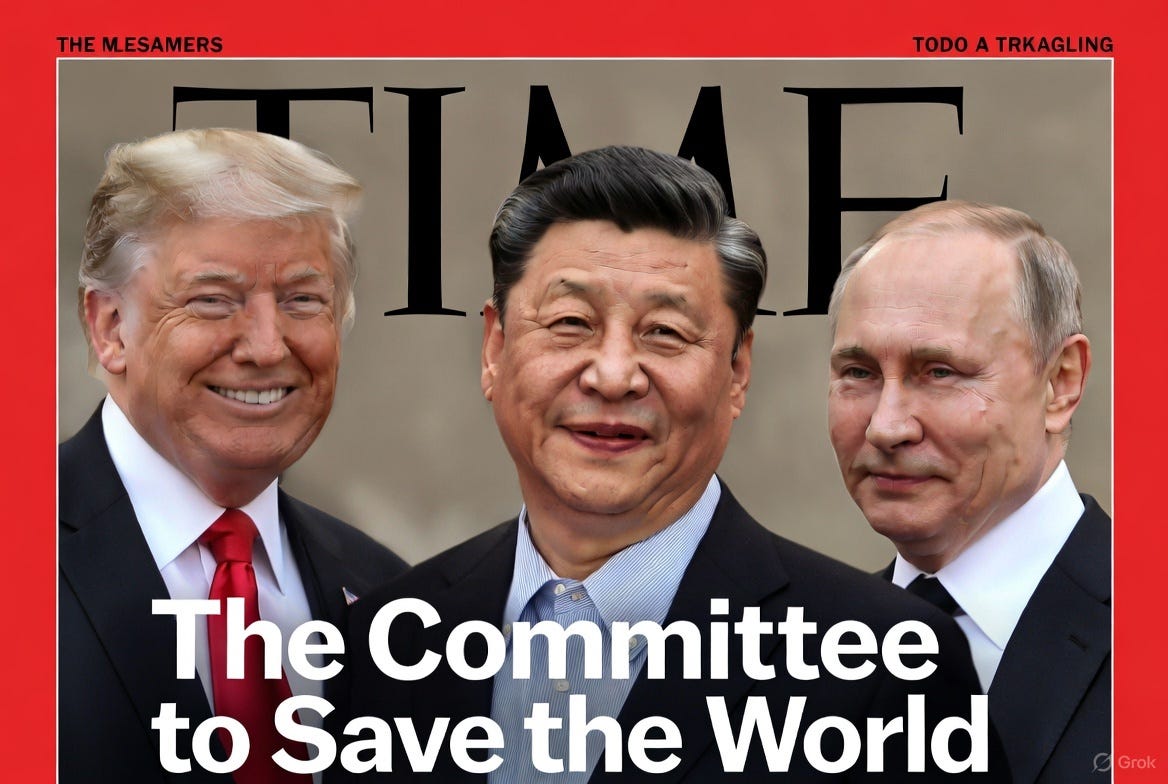
In the winter of 2025–26, as Donald Trump contemplates the oddly plausible scenario of another presidency, a fantastical yet even more plausible scenario presents itself: a grand bargain between Washington, Moscow and Beijing.
Russia would open its vast commodity spigots—oil, gas, nickel, palladium, wheat, timber; China would transplant its high-end factories to American soil or, more daringly, to the Russian Far East; and the United States, in return, would ease the sanctions on Russia and offer China a partial reprieve from technology denial. The three—Trump, Xi and Putin—would, in effect, attempt to redraw the economic map of Eurasia and North America in one sweeping gesture.
To Western ears this sounds like geopolitical science fiction but, to anyone steeped in the long rhythms of Eurasian history, it has an almost eerie familiarity. For a thousand years the steppe and the Middle Kingdom have traded grain for silk, furs for tea, horses for porcelain. The twentieth century interrupted that pattern with ideology and cold war; the twenty-first may quietly resume it under the guise of pragmatic nationalism.
This time is different
“The West’s greatest blindness has been its inability to imagine a world in which it is no longer the sole author of history.” Martin Jacques, 2012.
The difference now is that the third player is no longer a declining Britain or exhausted, post-war Europe, but the United States itself, until recently the world’s largest economy yet increasingly conscious of its relative decline and for which the benefits, if the stars align, will be colossal.
For the United States the prize would be a dramatic reduction in manufacturing costs and on-shoring of supply chains without the ideological baggage of “friend-shoring”. China-US JVs would contribute the latest technologies and invest in factories that boost US employment and lower imports dramatically, thus creating a vast new market for its trillions of dollars of surplus capital.
Russian natural gas liquefied on the Yamal peninsula would be shipped across the Pacific and undercut Qatar and Australia; Siberian nickel and cobalt would feed the American battery belt being built in Georgia and Kentucky. Inflation, Trump’s domestic nemesis in his first term, would be tamed by cheap energy and commodities. Politically, an Ukraine settlement brokered in Mar-a-Lago would allow him to declare “peace through strength” while freeing hundreds of billions for domestic infrastructure.
A grand bargain would reopen Western markets overnight. European and American refineries would once again buy Urals crude; Boeing and Airbus would resume titanium contracts; European farmers would face renewed Russian wheat. Chinese factories on Russian soil would bring investment, technology and—crucially—leverage against Beijing’s tendency to treat Russia as a junior partner. Putin could declare that Russia has broken out of isolation without surrendering an inch of Ukrainian territory.
Obstacles of our own devising
The obstacles are mountainous and not merely technical, but civilizational. The first and most obvious is trust: since 1918, the US has spent $1 billion every year instilling fear and distrust of the two giants in its citizens and the EU has invested even more – while Russia and China have spent decades constructing a ‘no-limits partnership,’ precisely because both believe the United States seeks their strategic defeat.
Abandoning their partnership for an American embrace would require a level of confidence in America’s word that no Russian leader since Gorbachev has possessed. Xi, for his part, remembers the century of humiliation and, more recently, American technology sanctions; he is unlikely to stake China’s industrial future on the whim of an American election cycle.
The second obstacle is the West itself, or rather what remains of the American-led alliance system. Any relaxation of sanctions on Russia would fracture NATO faster than any Russian tank column ever managed. Germany, Poland and the Baltic states would see it as a second Yalta, a great-power deal over their heads. Japan and South Korea, already nervous about American withdrawal from Asia, would read the signals as an American retreat. And India, courted assiduously by both Washington and Moscow, would be appalled at the prospect of a new condominium that freezes the post-1945 order in place.
The bargain would therefore require Trump to spend political capital he may not possess, and to confront a national-security establishment that still thinks in zero-sum terms.
China’s priorities
The third obstacle is China’s own hierarchy of priorities. No grand bargain can leave
the Taiwan question unresolved, for example. So Washington would have to cancel weapons sales, withdraw all forms of recognition and personnel from the island, repudiate all form of interference there, and publicly acquiescence to Hong Kong-style ‘one country, two systems’.
Trust but verify?
Russia cannot deliver commodities without sanctions relief, China cannot move factories without guarantees against future American export controls, and the United States cannot offer either without Congressional approval and iron-clad enforcement mechanisms. The result is a negotiation of almost Byzantine complexity, vulnerable to sabotage by a single Congressional subcommittee or Taiwanese election.
Yet history is neither linear nor rational. The Eurasian landmass has a way of reasserting its own logic. When the Soviet Union collapsed, Western commentators declared the end of history; three decades later the steppe and the Middle Kingdom are quietly resuming their ancient status. And, realistically, a Trump–Xi–Putin bargain would merely accelerate a process that is already under way beneath the surface: the gradual reorientation of the world economy from the Atlantic to the Eurasian heartland.
Facing the inevitable?
Whether such a bargain ultimately serves the interests of the three countries or merely postpones a larger confrontation is, as Martin Jacques might say, a question only history can answer. What is certain is that the West’s unipolar moment is over, and the next world order will be negotiated not in Washington or Brussels, but in the old imperial capitals of Beijing and Moscow and – if Trump has his way – on the greens of a Florida golf club. The twenty-first century, it turns out, may belong less to democracies or autocracies than to those willing to sit down together and divide the world anew.
On the other hand..
Brian Berletic makes the sobering case that the USA has absolutely no intention of relinquishing hegemony.
Nice try, we can always dream! Trump has barely 6 months left before the midterms and then, he’ll have his hands tied, se he better hurry.