

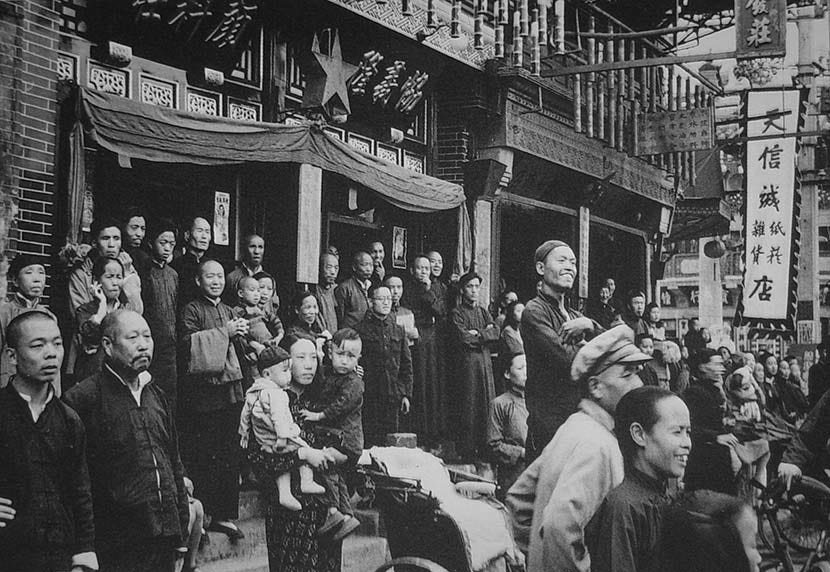
The waiting seemed endless, but there was a good-humoured patience which a Chinese crowd seems to be able to maintain without effort. There was an instant alertness, however, when a wave of excitement rippled down the crowd from the far end of the street. A few moments later the banners came in sight. The scene had been dull; black hair, blue clothes, generally dusty and tattered after long years of misery, grey brick walls above open shops, even the gold lettering of the black swinging signs were dulled and unwashed; but all this was suddenly brightened, lit as with the first rays of the sun.
The young were all singing at once—‘there is red in the East’—as the first of the countless red banners rounded the corner.There is little more beautiful, nothing more evocative, than hosts of red silken banners carried in a fluttering sea, high overhead. The golden stars sparkled; there was a great surge of feeling as the flags appeared and then passed us by.
Massive pictures held aloft were then carried past—the bearded German philosophers whose works were beyond us, Marx himself, before and behind them, and great hosts of leaders from every Communist land. But largest, held much the highest, was the father figure of all China, his mole, the seal of heaven’s approval, prominent on his benign face. With him was Chu Teh, the victorious fighter, head of the armies. Stalin and Lenin were there, and then a multitude of smaller pictures of political leaders, almost all of them western, and all very solemn.
Then came the dancers
Performing the yang go, those mythical traditional farmers’ dances which had truly become China’s own. There were troupes who accompanied the armies; but there were also local ones—most perfect of all the Birds of Spring and other young men and women who had learnt with precision on my lawn at Jen Dah. They were now gorgeously dressed in satin which gleamed bright blue and red, with white sashes and turbans; they beat cymbal and drum as they danced on the road.
The military section, in seemingly endless procession, was broken at times by more dancers who brought relief to the watching crowds. Repeated clusters of red banners rested the eyes, wearied from watching men and machines. We had expected to see Russian guns and tanks, and Russian advisers; but they were not there. Some of the guns were certainly German, won from Japan, but nearly all the equipment, guns, jeeps, rifles and tanks, were from the United States of America, either won fairly in battle, or else bought from Kuomintang leaders who valued the cash for personal reasons rather than the weapons they had no will to handle. There is much to be said in any civil war for both sides using guns and rifles of the same make.
There were trucks carrying bands, playing the national anthem, ‘Chi lai, Arise,’ which the young people knew and lustily sang, although until now forbidden. Mules carried machine-guns, trucks dragged the field-guns. There were stretcher bearers and Red Cross contingents, but mostly truck after truck of men and women in their sandy uniforms, bright stars on caps.
When the procession was over, the city had changed
Shops were open, every window flung wide, everywhere red flags were hanging, some hurriedly made, the five yellow stars made of paper, stuck with paste, some on cotton, some on silk. Spaces were cleared in the streets, as with the beating of drums and the rhythmic clash of cymbals, the yang go was danced up and down. The soldiers came to join in the revels; they were well fed and healthy, with clear, eager faces, so different from the ill-fed, dishevelled, hardly-ever-paid soldiers the people had known.
Many of the older people were quiet spectators, they had seen changes so often in their lives; while the rich, apprehensive about their future, doubtless remained behind doors.It was the day of young China, they were all out rejoicing: laughing, hand clapping, singing new songs. Liberation had come.
Out of the city at Jen Dah, the students were also dancing. A huge bonfire was lighted; and round it, in great circles, arms clasped, singing unity is strength, they all were fused in one great fellowship. The unbroken circles widened and then drew in, then out and in, again and yet again. It seemed as though the flames must scorch them.
That evening the newspapers appeared in new form. The Liberation Daily and the Duliang People’s News proclaimed that the era of liberation had commenced. The walls were suddenly bright with posters picturing the new freedom, and showing the shackles being cut from the feet of the poor and the oppressed.
They take babies and kill them
Liberation had come; but, while youth rejoiced, many of their elders secretly wondered what would follow when the singing had ended. High hopes in China had frequently been quickly dispelled and promises proved vain. My helper Mrs Fu, no longer to be thought of as a servant, sought me out in the quiet of my study. ‘You will know as you are a foreigner,’ she said in a whisper, so low I could hardly hear the name—‘speak although “they” ’—she would not mention the name—‘speak such good words and seem so friendly, they are not really good but are evil. They take babies and kill them. The woman at the Jen Dah main gate is frightened about hers, and wants to know if you will tell her what she should do.’ — I Stayed in China. William G. Sewell. A.S. Barnes Pub, NY 1966.
I’ve been rereading a number of your essays, Godfree, and am struck once again by China’s astute prescience, her assessment of her own weaknesses, lacunae, that would inevitably be exploited by the U.S. in the passage of time, so needed redress. Far sightedness is what will enable China to trump Tump and the next Trumps.