

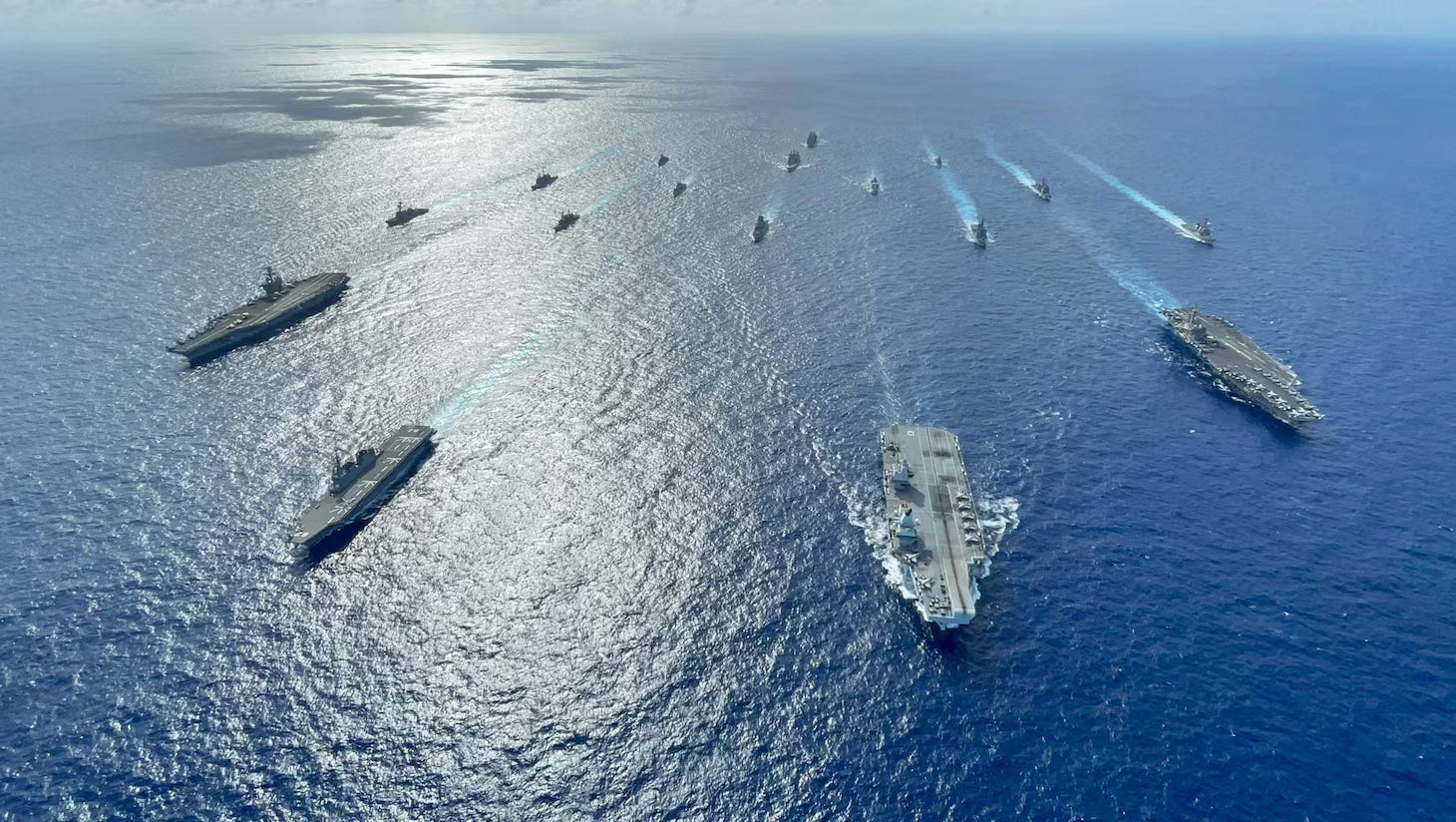
Taiwan, whose typhoons, reefs and minefields are Beijing’s natural moat, is 7,000 miles from America’s coast and 100 miles from China’s. So when China launches DF-21/26 ‘carrier killer’ missiles, they reach Guam in minutes. American carriers take two weeks. Even CSIS, which never met a war it didn’t like, shows that ‘winning’ U.S. scenarios lose 20 ships and 300 aircraft in the first week–and far more when it’s losing.
Forward Base Hostages
Guam, Okinawa, and Japan hold most U.S. strike aircraft—yet all lie inside China’s 1,500-mile missile envelope–to be unleashed by the PLA Rocket Force, which can fire 5,000+ ballistic and cruise missiles in the opening hours. As Ely Ratner testified to Congress in 2021: “U.S. bases in the Western Pacific are within range of thousands of precision Chinese strikes—complicating any rapid response.” Complicating indeed!
If the US responded to the loss of all its forward operating bases with a missile salvo, what could it target? Certainly not China’s Mainland.
100,000 Opening Missiles Salvo?
China’s dark factories, operating 24x7, each produce 1,000 missiles daily. The PLA’s annual production of the gigantic DF-series alone exceeds 10,000. Fully mobilized, Beijing could unleash 100,000 missiles in the first 72 hours—far beyond U.S. and allied interceptor inventories. “No layered defense can survive saturation of that scale.1” As Pete Hegseth warned on November 2024: “If 15 hypersonic missiles can take out our 10 aircraft carriers in the first 20 minutes of a conflict, what does that look like?”
Pacific Logistics
A single carrier strike group consumes 10,000 tons of fuel and ordnance daily while tankers and ammo ships must cross an ocean crawling with Chinese submarines and long-range bombers. By Week Two of a conflict, U.S. munitions stocks, already drained by Ukraine, would be exhausted.
Manufacturing Imbalance: 230×
China’s shipyards have 230 times America’s capacity and acquire high-end weapons six times faster (CSIS 2024). While the U.S. builds three submarines every four years,
China launches six and adds six warships annually—three times the U.S. rate–and it can resupply, rearm and repair its ships 2-3x faster. The PLAN’s missiles average 2-3x longer ranges (e.g., YJ-18 vs. Harpoon), enabling first-strike advantage.
America’s Empty Coffers, Beijing’s $3.3 Trillion War Chest
China holds $3.3 trillion in foreign reserves and borrows at 2% while the US, with $36 trillion debt, pays 5%. A high-intensity war could cost Washington $1 trillion a month—a rate that only China can support indefinitely.
Disunity of Command
80% of mainland Chinese support using force if necessary while only 41% of us favor defending Taiwan with troops2. At that level of support, ten thousand U.S. casualties in Week One would trigger nationwide protests and congressional paralysis.
Divided congressional loyalties with Israel could fracture U.S. unity of command in a highly likely Iran/Taiwan crisis. Aid, munitions, and diplomatic bandwidth are zero-sum; Israel packages would pass unanimously while Taiwan theatre supplies would stall. Rep. Brian Mast’s 2025 vow, to punish any UN body that investigates Israel, signals that Israeli sovereignty is a U.S. red line and that Middle East priorities override Pacific ones. Policy paralysis (delayed war funding), weak deterrence signaling and operational friction (assets or ammo diverted mid-conflict) vitiate American fighting power, allowing Beijing to exploit a divided chain of command and turn a three-week war into a three-day defeat.
Geography, missiles, production, fleet size, unity, and money all point the same way. If the U.S. intervenes directly, the war is decided in days—on China’s terms—and over inside three weeks. Hegseth’s stark warning isn’t hyperbole; it’s a call to Washington’s war-gaming delusionists. Failure to recognize our true situation isn’t just strategic malpractice—it’s a one-way ticket to irrelevance, where the Stars and Stripes flies over rusting hulks.
America’s choice? Adapt or atrophy.
USNI Proceedings (2024)
Chicago Council (2024)
A terrific essay, Godfree. Most informative. Thanks