

I asked a Chinese engineer friend what proportion of America’s spending on failed weapon systems China spends on successful ones. “I would be surprised,” he said, “if it were half as much”. Some systems he discussed:
Aircraft Carriers
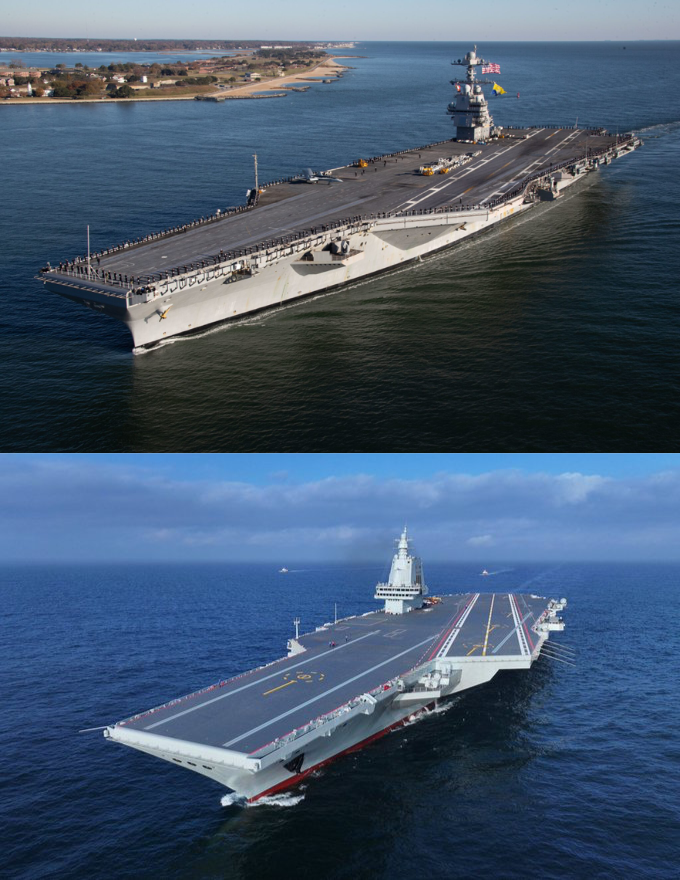
Construction of the $13+ billion USS Gerald R. Ford began in 2009. Its electromagnetic aircraft launch system (EMALS) cannot launch or recover the F-35 fighter, for which it was designed. Its problems are compounded by inadequate systems like the dual-band radar. China’s Fujian (Type 003) has a more powerful DC electric architecture for its EMALS, a bigger flight deck, and a wider array of defensive weapons. It is now operational.
Hypersonic Missiles
America’s 20-year ARRW hypersonic program cost around $15 billion and has been effectively scaled back or completed without full operational success. Chinese university science clubs have demonstrated hypersonic weapons. China’s DF-17, the Mach 10 “carrier killer,” has been operational for years and demonstrated many times. Its big brother, the DF-27, can hit ships well beyond Guam — with ranges reported up to 5,000–8,000 km and anti-ship capabilities that worry Pacific planners.
F-35 Fighters
From design to retirement, the F-35 program is projected to cost around $2 trillion. Each jet requires significant maintenance hours per flight hour. The Chinese J-20 carries a bigger payload, flies faster (up to Mach 2), higher, and further in some reported metrics, with missiles that outrange the F-35’s in certain configurations. (The F-35 retains strong advantages in sensor fusion and networking that are harder to quantify.)
Next-Gen Helicopter
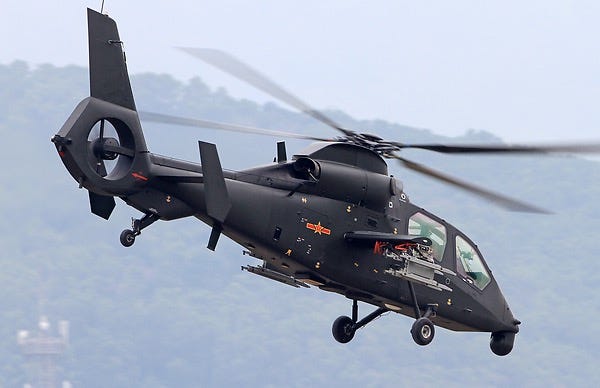
After spending $7 billion developing a reconnaissance and light attack helicopter, the US pulled the plug in 2004. China’s Harbin Z-19 is a tandem-seat helicopter for reconnaissance and light attack, armed with air-to-air and air-to-ground missiles plus a nose-mounted electro-optical target tracking turret. It’s in service.
Self-Propelled Howitzer
The Crusader was meant to replace the Army’s aging artillery — more mobile, longer range. It was canceled in 2002 after $2 billion was spent. China’s PLZ-05 155 mm self-propelled howitzer, PLZ-07 122 mm self-loading howitzer, and PCL-181 155 mm wheeled self-propelled, self-loading howitzer are all in full production and service.
Railgun
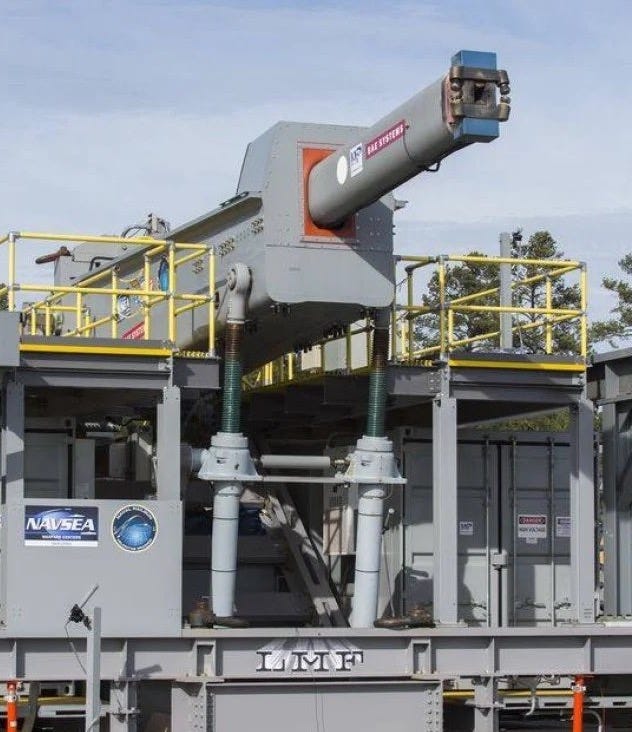
The Navy spent $500 million on the railgun program and canceled it in 2021. China’s railgun has fired 120 rounds at 4,500 mph (7,200 km/hr) and struck targets 120 miles (200 km) away. (Update 2026): The U.S. Navy conducted new live-fire tests of its prototype electromagnetic railgun at White Sands Missile Range in 2025. A railgun is a potential key feature on future Trump-class “battleships”.
Laser Cannon
The Air Force spent $5 billion developing a laser cannon then canceled it in 2012. China’s high-energy laser cannons remain powered up indefinitely without overheating, thanks to state-of-the-art cooling systems.
Next-Gen Destroyer: (2026 update).
The Zumwalt next-gen destroyer was supposed to launch missiles from its 80 VLS cells. After spending $22 billion for just three ships, the Navy effectively reconfigured the program. The ships’ unit cost has ballooned to around $9.5 billion each with recent hypersonic upgrades. The lead ship USS Zumwalt is still working toward full operational capability with Conventional Prompt Strike missiles replacing the original guns. China’s Type 055 next-gen destroyer has 112 VLS cells and is in series production — with multiple ships commissioned and more entering service.
ICBMs
The US Air Force has paused and restructured work on its Sentinel intercontinental ballistic missile program due to escalating costs. Chinese and Russian cutting-edge missiles continue to tilt the global nuclear balance.
Maintenance and Industrial Base Struggles
The Navy has inactivated older submarines like the Boise (commissioned 1992) amid ongoing maintenance backlogs and shipyard capacity issues. The Zumwalt remains one of the world’s costliest destroyers, still working through upgrades.
Real-World Confirmation: 2025 Production
In 2025 the PLAN commissioned 1 carrier, 1 Type 055 cruiser/destroyer, 7 Type 052D destroyers, multiple frigates (including 054A/B variants), and submarines. The US Navy commissioned 0 major surface combatants and roughly 1–1.5 Virginia-class submarines. China’s navy (already the world’s largest by hull count — over 370 ships) continues growing rapidly while the US fleet struggles to maintain size and momentum.
To a student of human history the woeful state of America’s national security establishment does not appear as some sort of great mystery. It is far from unique; in fact, it might not even be noteworthy. It is just the normal stuff of human history, going back thousands of years. ... America’s empire is not actually very exceptional; it is far more similar to than different from history’s many other empires that have all risen to wealth and glory only to then fall away.” American Affairs, Spring 2025. — Malcolm Kyeyune
Last Updated April 2026. This is a living post. New data on programs, costs, and deployments will be added as the picture evolves.
Notes
1 To get a sense of how massive this problem actually is, the 2022 Government Accountability Office report on weapon system sustainment for airframes is a good starting point. Almost every airframe type used by the services has growing and very serious sustainment bottlenecks. U.S. Government Accountability Office, “Weapon System Sustainment: Aircraft Mission Capable Goals Were Generally Not Met and Sustainment Costs Varied by Aircraft,” November 2022.
2 See, for example, Jerry Hendrix, “Sunk at the Pier: Crisis in the American Submarine Industrial Base,” American Affairs 8, no. 2 (Summer 2024): 22–34; U.S. Government Accountability Office, “Navy Readiness: Actions Needed to Address Costly Maintenance Delays Facing the Attack Submarine Fleet,” November 2018.
3 Though it is beyond the scope of this essay, it should nevertheless be noted that the extent of the current recruitment crisis is often severely understated in the media. The debates around this issue tend to focus on the military’s struggles to meet its on-paper authorized strength and its peacetime commitments. What’s less often talked about is that the U.S. military at present has essentially no realistic way to absorb and replace any casualties in real warfare: Katie Crombe and John A. Nagle, “A Call to Action: Lessons from Ukraine for the Future Force,” US Army War College Quarterly: Parameters 53, no. 3 (Autumn 2023): 21–31.
4 See, for example, David B. Larter, “‘You’re on Your Own’: US Sealift Can’t Count on Navy Escorts in the Next Big War,” DefenseNews, October 10, 2018.
5 Davis Winkie, “Broken Track: Why the Iron Knights Chose to Speak Out about Suicides,” Army Times, March 12, 2024; Janet Reitman, “A Disaster of the U.S. Military’s Own Making,” New York Times, June 19, 2024.
6 Sam Lagrone, “‘Poor Material Condition’ of Navy Amphib Fleet Prevent Marine Deployments, Training, Says GAO,” USNI News, December 3, 2024.
7 Leonard Wong and Stephen J. Gerras, Lying to Ourselves: Dishonesty in the Army Profession (Carlisle, Penn.: U.S. Army War College Press, 2015).
8 For those unfamiliar with this controversy inside the mid-2010s Navy, the award-winning ProPublica investigation is a good entry point: T. Christian Miller, Megan Rose, and Robert Faturechi, “Fight the Ship,” ProPublica, February 6, 2019.
While I largely agree with Dr. Roberts that the widening U.S.-China military gap is no longer just a technology gap, it is a gap in industrial organization, I do not think the growing gap can be explained simply by saying that America’s privatized defense industry is greedy while China’s state-owned defense industry serves the nation. If that were the whole story, it would be hard to explain why the United States maintained the world’s most competitive military-industrial complex for much of the second half of the twentieth century. This is where my view departs from Roberts’. The deeper reason is that the two countries have diverged more fundamentally in the logic of how their defense industries are organized.
The first layer is strategic environment. China’s military task over the past twenty years has been to close capability gaps quickly in near-seas denial, regional sea control, air and missile defense, Rocket Force strike capacity, naval shipbuilding expansion, and preparation for intense conflict on its periphery. That naturally favors quantity, tempo, cost control, systems integration, and industrial replicability. The United States, by contrast, spent the past three decades sustaining global primacy. It became used to designing highly complex, multi-theater, alliance-centered, function-stacked platforms. The result is a system that too often loads every cutting-edge requirement into one platform and then loses control in execution.
The second layer is the industrial base, especially shipbuilding and manufacturing ecosystems. China’s strongest advantage does not come from being ahead in every frontier technology. It comes from the fact that behind its military production stands a vast civilian foundation in shipbuilding, steel, electromechanical systems, heavy industry, electronics, materials, and port logistics. That industrial depth gives China a scale effect and resilience the United States increasingly struggles to match.
The third layer is that the U.S. defense sector has become trapped in a model of extreme complexity, low production volume, long development cycles, and oligopolistic contracting. The United States can still innovate. The problem is that its innovation is often locked inside a system that is extraordinarily expensive, compliance-heavy, subcontracted, and politically fragmented. Once a project is dominated by a few prime contractors, and then shaped further by congressional district politics, multistate subcontracting, sustainment incentives, and audit burdens, the result becomes predictable: systems grow more intricate, costs rise, delivery slows, and course correction becomes harder.
The fourth layer is that China’s institutional advantage is not simply that the state can issue commands. It is that the feedback loop among the state, state-owned enterprises, local industrial chains, research institutes, and commercial manufacturing is much shorter. That allows faster iteration, faster scaling, and a more effective conversion of industrial capacity into deployable military capability.
the J-20 fighter is far superior than F-35 in speed, range, firepower and radar tech: Mach 2 vs. Mach 1.6 top speed, 2,000 km combat radius vs. 1,000 km, flight ceiling 66,000 feet vs. 50,000 ft, PL-15 air-to-air missiles (range up to 300 km) vs. AIM-120D (max range 180 km), and GaN AESA radar vs. GaAs radar (one generation ahead). the F-35s delivered in Lot 17 and up to Lot 20 (2027) are expected to be radarless, since the older radar doesn't fit with the new nose of the jet. Lockheed uses gym weights in the nose to balance the jet. It is flyable but blind.
J-20 is a twin engine heavy air superiority jet vs. F-35 a single engine multirole jet. So F-35 is not even in the same weight class as J-20. F-22 is a better comparison but it suffers from dated technology (radar, sensor fusion, avionics from the 1990s) and production long halted.
Chinese PCL-191 is far more powerful than HIMARS in range and firepower. it is a much larger, heavy-duty 8x8 platform compared to the lighter 6x6 US system. If it fires 370mm guided rockets, the max range is 370 km, with 750 mm Fire Dragon missile, the max range is 500 km. In comparison, HIMARS max range for rockets is 90 km, for ATACMS is 300 km. PCL-191 also has far larger payload and caliber.