

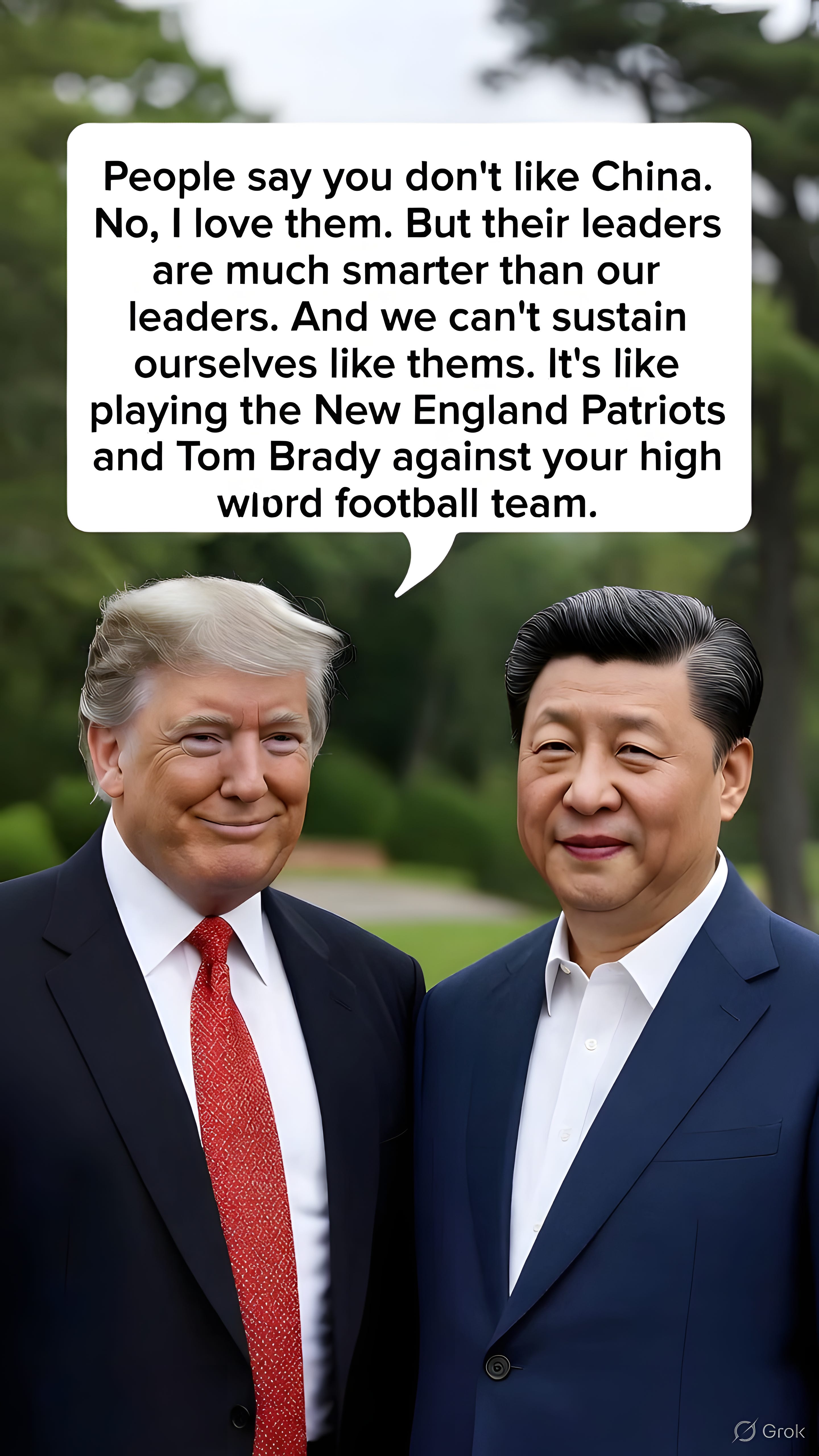
Handshakes then, chokehold now. China owns 96% of rare earths US military needs. Stockpiles dry in 2 months.
#RareEarthShortage #USChina
You are the front gate of the great continent, and we are the rear. They created Israel for you, and Taiwan for us. Their goals are the same. Mao Zedong to Ahmad Shukeiri, 1965.
Mao’s words, above, captures China’s long game and today the long game is paying off as never before: China controls 96% of the rare earths America needs to keep its military flying and sailing. When the stockpiles run dry in two months, will it be ‘great deals’ or great concessions?
America’s Rare Earth Shortage: Two Months’ Military Supply Left
The United States faces a critical rare earth shortage. Military stockpiles reportedly hold just two months of essential supplies. China maintains near-total control over high-purity rare earth refining. Beijing can literally dictate how long America sustains operations in conflicts like Iran.
Today, Xi Jinping holds a card no adversary has wielded since the USSR aimed missiles at American cities: the power to choke the U.S. military by restricting rare-earth exports.
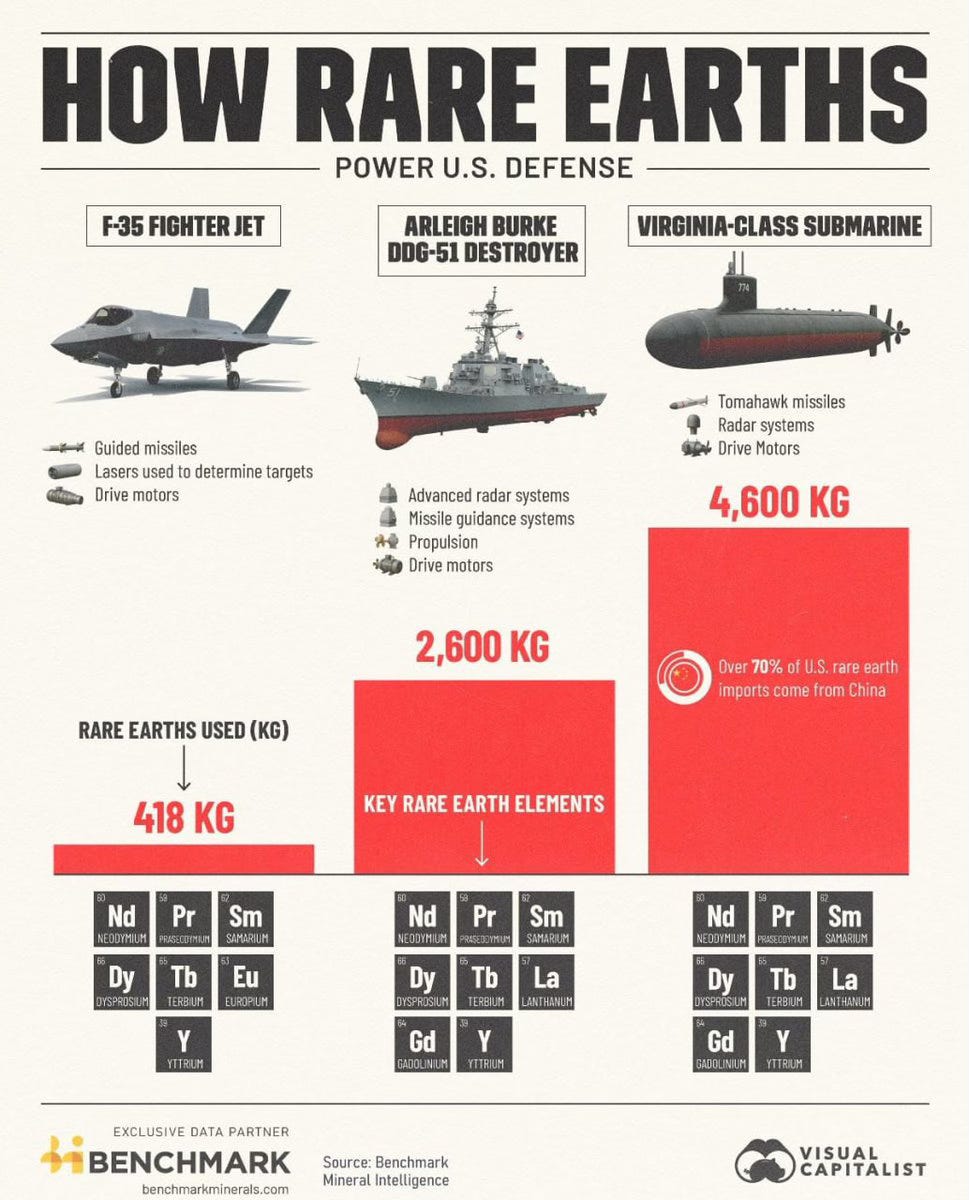
China’s rare earth restrictions already target defence applications. They use dual-use export bans that forbid sales to arms manufacturers. Yet no strategic asset gets built without these materials. F-35 jets and precision-guided munitions both require rare earths. The Pentagon’s supply chains run through China. Beijing controls 96% of global refining capacity for the high-purity grades (99.999% (5N) to 99.99999% (7N)) essential to defence.
The US consumes neodymium, dysprosium, terbium, yttrium, and scandium at high rates. Even before the Iran war, these consumption rates strained limited stock stockpiles. In the first two weeks of that conflict alone, America burned through 30 tonnes of REEs.
Xi may offer life support in exchange for closing every American base in Asia. Trump, a military amateur, has no easy answer. Refined REEs are the fulcrum of superpower balance. This is why professionals talk logistics..
Imperial humiliation: Red Sea reckoning?
Many empires have crumbled on the Red Sea shores. Iran has watched it all. The most recent precedent came in 1956. Egypt nationalised the Suez Canal, a lifeline for British trade and imperial prestige. Britain, France, and Israel launched an invasion to seize control. Royal Navy paratroopers took key positions. Yet within days, US economic pressure forced a humiliating withdrawal. The U.S. threatened to withhold IMF loans and sell sterling reserves. Soviet nuclear warnings added to the pressure. The Falklands War, a quarter-century later, was imperial nostalgia at best. Margaret Thatcher invoked Churchill to rally support. But the attempt to revive faded dominance proved futile. Imperial-era power no longer translated into independent action.
America’s imperial moment of reckoning unfolds at the opposite end of the Red Sea. If Xi refuses outright REE relief or conditions it on base closures, the U.S. Navy faces
cascading shortages.Carrier strike groups and submarine fleets are stretched thin. They operate across the Caribbean, Ukraine, Iran, and the Pacific, and all will face shortages of precision-guided munitions, radar arrays, and sonars.
If Houthi attacks in the Bab el-Mandeb have not already done the job, the inability to replenish high-purity, REE-dependent weapons will render American naval superiority a hollow boast. Like Britain’s, its prestige will collapse if it depends on Chinese inputs to sustain its industrial base.
A history of failure: $15 Billion Spent, Zero Weapons-Grade Success
Between 2010 and 2025, the United States and Japan poured $15 billion into rare earth refining and failed to produce one batch at 5N or 6N weapons-grade purity for defense systems.The implications are stark. The U.S. fights a 2026 war with a 1990s industrial mindset: it cannot sustain Operation Epic Fury when $1.1 billion AN/FPS-132 radars require 77 kg of gallium.. and China controls 98% of global gallium supply.
The military consumes 1.5 years of missile production every 14 days. Yet the rare earth gap stretches replacement lead times into years.
President Trump’s delayed Beijing summit is not an ordinary diplomatic mission. It’s a desperate bid to beg Xi to keep America’s defense industry alive. The Arsenal of Democracy survives on Chinese goodwill.
The here and now: 2026-2027
If Trump rejects Xi’s terms, US rare earth stockpiles dwindle within weeks.F-35 production halts. Each aircraft requires 920 pounds of rare earths.This delays urgent fleet replenishment.Tomahawk and Patriot missiles face shortages. Contractors like Raytheon ration supplies, prioritizing active conflicts over new builds. The Pentagon reallocates from civilian sectors (EVs and AI, both surging in demand). This drives prices higher. Allies Japan and South Korea suffer parallel restrictions. Collective deterrence weakens.
The economic shock hits immediately. Over $100 billion in delayed contracts and job losses emerge in defense hubs from Huntsville to Fort Worth to Culver City. Trump’s options narrow fast. He can escalate rhetoric or impose secondary sanctions on Chinese firms. He can accelerate domestic mining or recycle existing REEs, but they don’t close the refining gap. Partial concessions remain possible. He could allow limited quotas for non-military uses while pressuring allies to diversify. Or he walks away, betting domestic mobilization and allied stockpiles buy time. Each path carries risk: escalation looks weak to his base, concessions invite accusations of capitulation, refusal risks visible military degradation before 2028.
Mid-Term Trap: 2028–2030
Virginia-class and Columbia-class submarines. Each requires 9,200 pounds of REEs. This erodes undersea superiority. Radar and electronic-warfare systems degrade. CSIS predictions show the US munitions buildup is five to six times slower than China’s. Defence spending balloons to fund alternatives. Malaysia projects 16-19 thousand tonnes of NdPr separation; Australian ionic-clay projects advance. Yet 5N+ purity remains elusive. Inflation spills into EVs and consumer tech. One to two kg of REEs per vehicle slows the green transition. GDP growth slows by 0.5%-1%. Jobs shift towards mining and recycling, but environmental costs mount. Diplomatically, alliances fray as Washington pressures partners for REEs they cannot yet supply.
The Long Goodbye. 2031–2036: Multipolar Shift
By 2031, even with maximum effort, high-purity refining remains five to seven years away. Military readiness erodes. Pacific deterrence weakens. Taiwan contingencies grow riskier as China exploits gaps. Innovation in lasers, missiles, and next-generation radar slows. America’s share of global high-tech manufacturing drops ten to fifteen per cent. The economic pivot ramps up. Over $30 billion in domestic projects fund the proposed Project Vault reserve. But the ten-year lag leaves persistent vulnerabilities. China consolidates dominance. It controlled 270,000 tonnes of refining capacity in 2024 and continues expanding steadily – accelerating the transition to a multipolar world. U.S. alliances fray further. $2 trillion annual defence budgets fuel both debt growth and domestic resentment.
TINA’S back in town
There is no realistic alternative. The United States Military will depends on Chinese goodwill until ~2050. No combination of tariffs, subsidies, allied diversification, or domestic mining eliminates that window. Acknowledging this reality is the only honest starting point for policy. Whether the path is confrontation, negotiation, or managed decline depends on this acknowledgement.
If Xi makes the offer, rare earth relief comes with a price: base closures. Later this year, his shot locker empty, Trump will face Eden’s 1956 dilemma: the material foundation of great-power status has shifted beneath his feet; he can accept terms that shrink the American footprint in Asia, or watch his military wither. Either will mark the end of the post-1945 world order. The name of the other strait in the Red Sea, Bob al Mandab, means ‘Passage of Tears’. The Houthis plan to close it again next week
Further Reading
China’s rare-earth mineral squeeze will hit the Pentagon hard.
Hegemony or Survival. Noam Chomsky.
Blast from the past:
China, Rare Earths And The End Of The World As We Know It.

Welcome to our biannual reckoning with the rare earths conundrum. In last June’s dispatch—China, Rare Earths and Intellectual Property—I asked who, precisely, will underwrite the construction of factories requiring two decades of unswerving political support, legions of scientists, millions of laborers and hundreds of billions of dollars in outlays? And what if – like Japan’s fifteen-year, multi-billion dollar effort – it yields neither a commercial profit nor even a viable product?
If you found this analysis useful, consider subscribing for more deep dives into US-China strategic vulnerabilities and the shifting global order.
Roberts supplies the case history. Requisite Realism supplies the ontology. Together they shift International Relations from a theory of strategic intention to a theory of material constraint, where power is measured not by what states plan or possess, but by what they can sustain. It is structural realism with its missing variable restored: material constraint.
See my working paper on Requisite Realism here:
https://alkoch55.substack.com/p/requisite-realism?