

The simple facts of Mao’s career seem incredible. In a vast land of 400 million people, at age 28, with a dozen others, to found a party and in the next fifty years to win power, organize, and remold the people and reshape the land–history records no greater achievement. Alexander, Caesar, Charlemagne, all the kings of Europe, Napoleon, Bismarck, Lenin–no predecessor can equal Mao’s scope of accomplishment, for no other country was ever so ancient and so big as China. Indeed Mao’s achievement is almost beyond our comprehension. John King Fairbank.
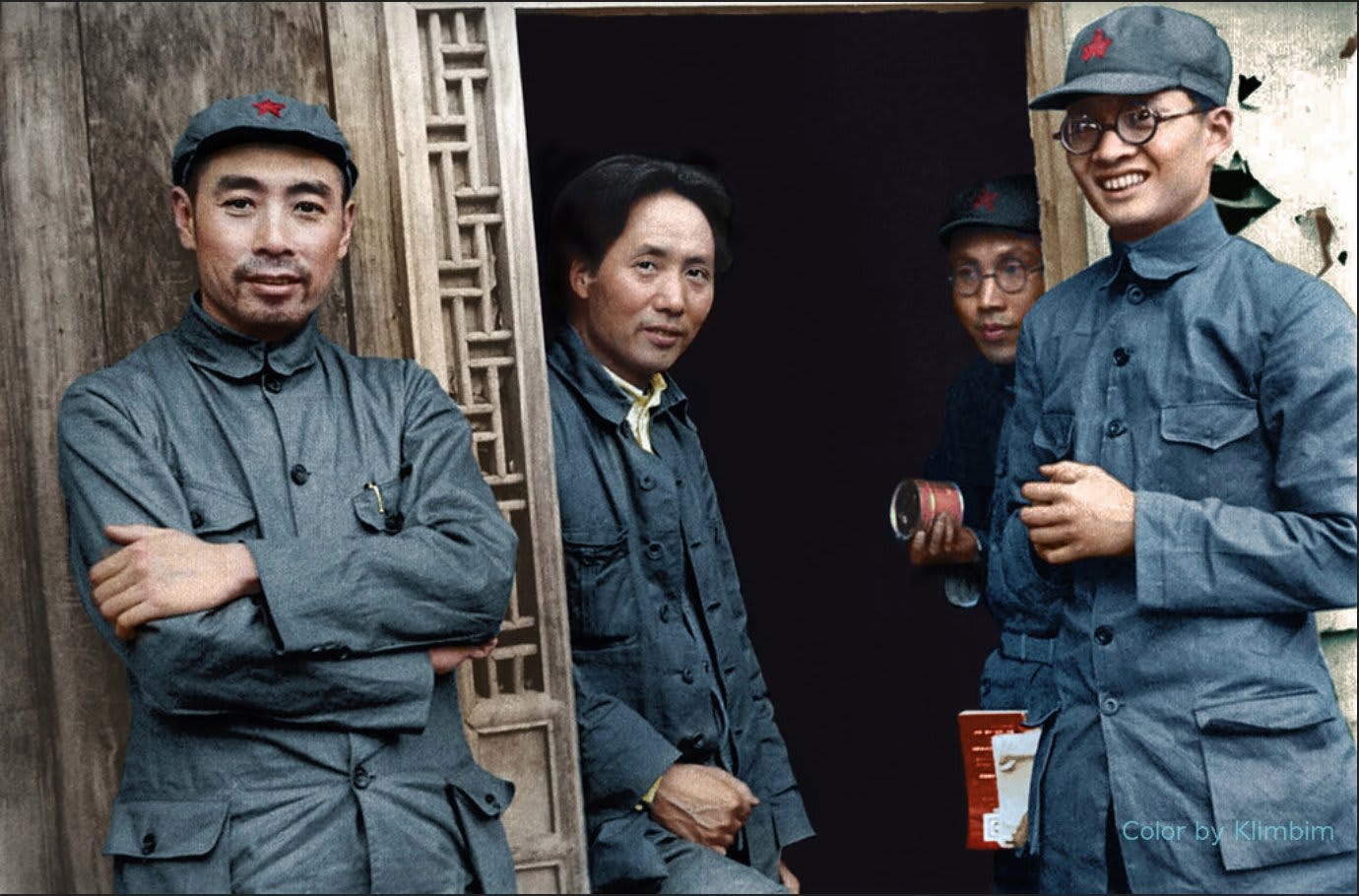
As a civilization-state with millennial roots, China under Mao emerged from semi-colonial, destitute fragmentation, endured a profound yet peaceful reconfiguration, and laid the foundations for its global role. Far from the caricatures prevalent in Western narratives, Mao’s era marked unprecedented advances in social harmony, equity, resilience and unity, achieving rapid modernization despite external embargoes and internal challenges. The changes Mao wrought to accomplish this were characterized by their speed of execution, their scope, permanence and impact on the world. Here are some of the more prominent:
Half the Sky
Whatever male comrades can accomplish, women comrades can too. Women hold up half the sky.
Long before he became a revolutionary, Mao campaigned nationally for women’s rights, which culminated in his signing of the 1950 Marriage Act. The first bill signed into PRC law, it abolished arranged marriages, concubinage and child betrothals while granting women equal rights in divorce, property, and custody. The reform also elevated women’s labor participation to 90% in some sectors and contributed 41% of China’s GDP growth.
Organizer
We Communists are like seeds and the people are like the soil. Wherever we go, we must unite with the people, take root and blossom among them.
Mao shifted the Party’s mobilization efforts from traditionally Marxist cities to the countryside through the All-China Peasants’ Union and Training Institute in Wuhan, where, by 1927, he had trained millions of cadres in land reform and armed self-defense. His Hunan Report1, which became a handbook for global organizers, enabled peasant associations to function as proto-unions, redistributed land to millions, and boosted agrarian productivity 2.5%2.
Commander
Never be afraid to negotiate; never be afraid to retreat; never be afraid to change your plans; never be afraid to attack.
Though his forces were heavily outnumbered and underequipped, Mao’s guerrilla
tactics—encapsulated in principles like the Four Nevers above, and rhythmic marching songs that taught field maneuvers—defeated well-funded and heavily-armed Nationalist forces ten times larger. His field manual, On Guerrilla Warfare, is studied at modern military academies everywhere. Key victories, like the Four Crossings Battle, reversed the civil war, enabling China’s unification and victory in Korea. Field Marshal Bernard Montgomery compared Mao’s campaigns favorably to Alexander’s and Napoleon’s.
Revolutionary
A revolution is not a dinner party, nor writing an essay, nor painting a picture nor doing embroidery; it cannot be so refined, so leisurely and gentle, so temperate, kind courteous, restrained and magnanimous. A revolution is an insurrection, an act of violence by which one class overthrows another. A rural revolution is a revolution by which the peasantry overthrows the power of the feudal landlord class. Without using great force, the peasants cannot possibly overthrow the deep-rooted authority of the landlords, which has lasted for thousands of years. The rural areas need a mighty revolutionary upsurge, for it alone can rouse the people in their millions to become a powerful force. Leadership by the poor peasants is absolutely necessary. Without the poor peasants there would be no revolution. To deny their role is to deny the revolution. To attack them is to attack the revolution. They have never been wrong on the general direction of the revolution. Report on an Investigation of the Peasant Movement in Hunan (March 1927), Selected Works, Vol. I, p. 28.
So well did Mao manage the three biggest revolutions in history – land reform, the industrial revolution and the Cultural Revolution – that they all achieved their goals peacefully.
Businessman
China must industrialize. This can only be done by free enterprise. Chinese and American interests fit together, economically and politically. America need not fear that we will not be co-operative. We cannot risk any conflict”. Mao, to Presidents Roosevelt, Truman and Eisenhower. [Tuchman].
Influenced by his father’s rise from poverty to landownership through commerce, Mao applied the business skills he learned in childhood to revolutionary enterprises and founded global giants like PBOC, State Grid and Sinopec, fostering self-reliance amid sanctions, increasing output fortyfold and transforming an industrial base smaller than Belgium’s into one of the world’s largest. In 25 years.
Democrat
What does democracy consist of? On what forces does it rely? How does it express itself? To some extent, of course, it expresses itself in the ballot box. It also expresses itself in the deliberations of the village councils, in the opinions seeping up through the ranks of the army, in the resolutions of county governments, in the overt signs of change which appear in the political atmosphere of the times. The main task of the leader is to keep his ear to the ground. – On The New Democracy
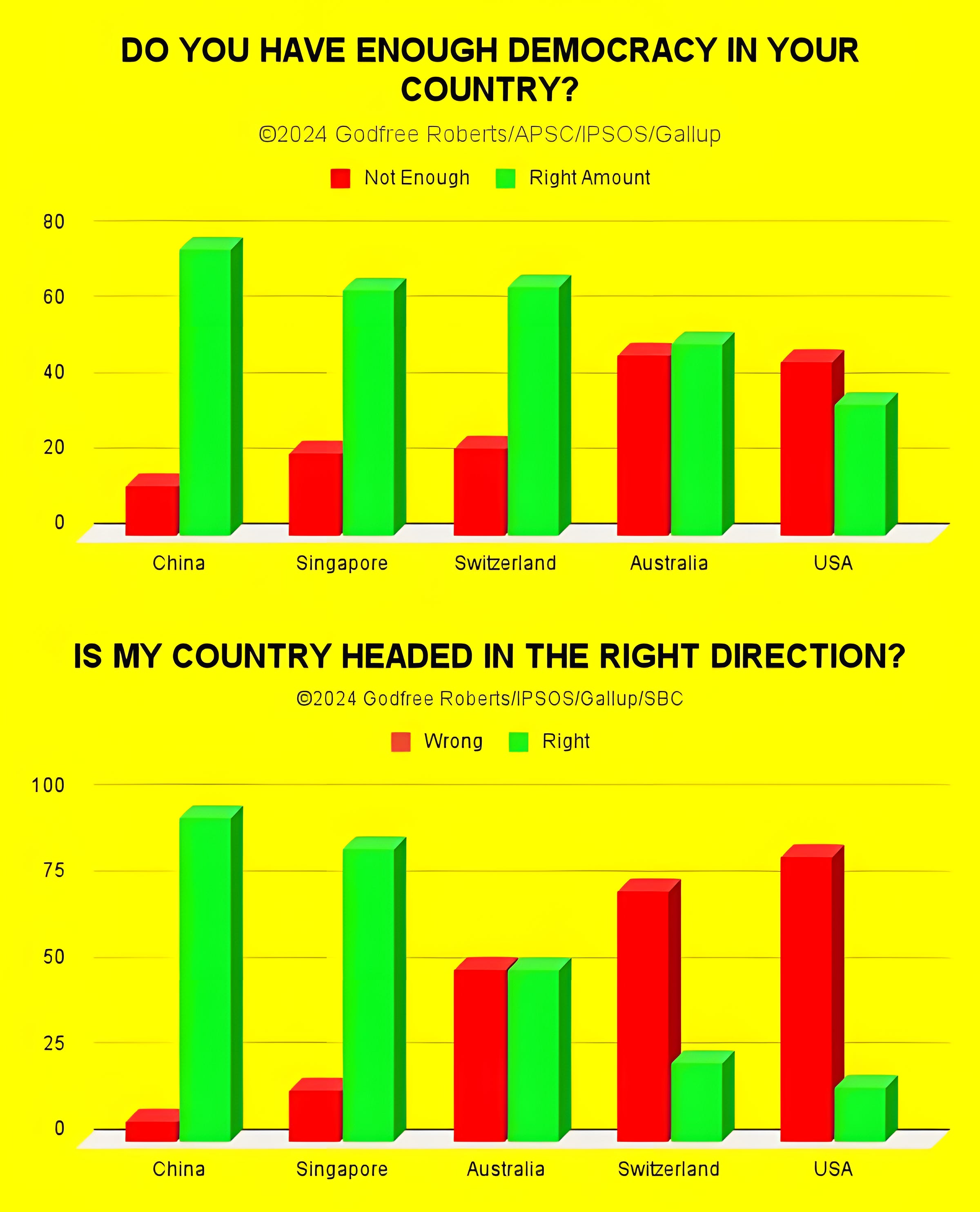
Asked what kind of government he was planning for China Mao replied, “It will implement Dr Sun Yat-sen’s three principles of democracy, Lincoln’s principle of ‘of the people, by the people, for the people,’ and Roosevelt’s Atlantic Charter”. As good as his word, Mao democratized Confucian governance and made it exactly what we would expect of a real democracy: responsive, efficient, popular and trusted.
Reformer
To divide up the land is nothing remarkable — MacArthur did it in Japan. Napoleon divided up the land too. Land reform cannot abolish capitalism, nor can it lead to socialism. Mao Zedong.
In just three years, Mao managed the largest land reform in human history–with little or no bloodshed. In the three years of the equally bloodless and ultimately failed Great Leap Forward he revolutionized China’s water and irrigation systems and built most of its dams. In the ten years of the peaceful Cultural Revolution (which he called his proudest accomplishment) he emancipated 400,000,000 serfs from 3,000 millennia of bondage and taught them to read, write, vote, care for their health and run the country. Any of these revolutions would have made another leader famous, but all of them? Bloodlessly?
Visionary
Like a man, a political party has its childhood, a youth, manhood and old age. The Communist Party of China is no longer a child or a lad in his teens but has become an adult. When a man reaches old age, he will die, and the same holds true of a party..For the working class, the laboring people and the Communist Party the question is not one of being overthrown but of working hard to create the conditions in which classes, state power and political parties will die out very naturally and mankind enters the realm of Great Harmony, dàtóng. Mao Zedong, 1949.
Leaders like Deng and Xi have given their names to economic eras but Mao Thought remains the core of the China Dream. His emphasis on the mass line3, self-reliance, continuous struggle against class enemies, and his peasant-centered socialism are the ideological foundation for the Party’s claim to legitimate rule, national rejuvenation, and a path distinctively different from Western liberalism. Every aspect of Mao’s leadership embodied a vision of collective progress, of long-term, high-level goals that unite diverse populations through discipline and pragmatism and, above all, the vehicles to reach them.
Developmental Economist
It is only forty-five years since the Revolution of 1911, but the face of China has completely changed. In another forty-five years, in 2001, the beginning of the 21st century, China will have undergone an even greater change. She will have become a powerful socialist industrial country. (1956).
Mao pioneered a new type of state capitalism under socialist oversight, prioritized public needs over private profit, achieved 6.4% annual GDP growth from 1952-1978 (surpassing Germany’s 3.3% and Japan’s 4.3%). Steel output rose from 1.4 to 31.8 million tons, and urban workers grew from 3 to 18 million; self-reliance yielded nuclear and aerospace breakthroughs by 1970, with industry’s share of GDP hitting 72%, laying groundwork for China’s economic dominance we see today. Life expectancy doubled from 35-40 years in 1949 to around 70 by the late 1970s, while literacy rates surged from under 20% to over 66% by 1982. No leader in history has led such a profound and rapid transformation.
Politician
What is politics? Politics is to reduce the number of enemies and increase the number of friends. Make our side bigger and the enemy’s side smaller. Mao Zedong
Mao unified his country from chaos, defeated imperialism and feudalism and re-established Chinese sovereignty. His bloodless land reforms empowered peasants, women’s rights elevated half the population and diplomacy normalized U.S. ties, reshaping geopolitics. Though never possessing the executive powers of an American President, Mao won near-unanimous support for all of his adventures and experiments – from a Cabinet not of his choosing. No leader in history has maintained such political support for so long on such diverse and divisive policies.
Confucian
Confucius’ failings, I believe, were that he was not democratic and that he lacked a spirit of self-criticism; he was a bit like Mr. Liang … There is a good bit of the work-style of the bully in Confucius, and there is something of a fascistic flavor. I wish that my friends, especially Mr. Liang, would not follow the ways of Confucius. I’ll be most gratified if you don’t. Mao Zedong, Legalism and Confucianism.
Modeled on the Duke of Zhou’s selfless regency, Mao embodied the Confucian junzi4 – a man of moral maturity, compassion (ren), righteousness (yi), and humility (li) serving others selflessly. But it is the scope, the speed, the ambition and the lasting impact of his reforms that mark him as the greatest man in human history. Once again:
The simple facts of Mao’s career seem incredible. In a vast land of 400 million people, at age 28, with a dozen others, to found a party and in the next fifty years to win power, organize, and remold the people and reshape the land–history records no greater achievement. Alexander, Caesar, Charlemagne, all the kings of Europe, Napoleon, Bismarck, Lenin–no predecessor can equal Mao’s scope of accomplishment, for no other country was ever so ancient and so big as China. Indeed Mao’s achievement is almost beyond our comprehension. John King Fairbank.
It decisively shifted revolutionary focus from urban proletariat (as per orthodox Marxist-Leninist doctrine and Comintern advice) to the peasantry as the main revolutionary force; It demonstrated investigation and research as essential CCP methodology: Mao spent 32 days in Hunan personally observing peasant associations, violence against landlords, and rural dynamics, then used empirical evidence to challenge party skeptics. This “from the masses, to the masses” approach (ground-level investigation → theory → policy) became a core Maoist principle, influencing everything from land reform to mass line tactics. In later years, it served as a template for mass mobilization campaigns
A pivot that aligned with China’s agrarian civilizational base and outpaced Japan’s Meiji reforms in rural empowerment.
Mao’s key contribution was systematizing, deepening, and Sinicizing the mass line into a distinctive, practical leadership method suited to China’s rural, semi-colonial conditions. He gave it its classic formulation in 1943: “In all the practical work of our Party, all correct leadership is necessarily ‘from the masses, to the masses.’ This means: take the ideas of the masses (scattered and unsystematic ideas) and concentrate them (through study turn them into concentrated and systematic ideas), then go to the masses and propagate and explain these ideas until the masses embrace them as their own, hold fast to them and translate them into action, and test the correctness of these ideas in such action. Then once again concentrate ideas from the masses and once again go to the masses so that the ideas are persevered in and carried through. And so on, over and over again in an endless spiral, with the ideas becoming more correct, more vital and richer each time. This is the Marxist theory of knowledge.”
Prince, Gentleman-Scholar.
Great piece! To the list of what Mao was, you could also add Poet and Calligrapher. Mao wrote some of the most magnificent Chinese poems of all time, and his cursive style calligraphy, which fully expresses the heroic abandon aspect of his personality, is first class. The land reform, which liberated China's hundreds of millions of poor peasants, and the laying of the foundation of heavy industry, both thanks to Mao, are two crucial building blocks of the unprecedented success of China's development in the last four decades. My personal opinion is that Mao was at least one the greatest human beings ever, and arguably the greatest.
Il n'est point de secret que le Temps ne révèle.
Jean Racine 1680