

I asked a Chinese (civil) engineer friend to estimate what proportion of America’s spending on failed weapon systems China spent on its successful ones. He would be surprised, he said, if it were half as much. Here are some systems we discussed:
Hypersonic Missiles: America’s 20-year, failed ARRW hypersonic missile defense program cost $15 billion. Chinese university science clubs have demonstrated hypersonic weapons. China's DF-17, Mach 10 ‘carrier killer’ has been demonstrated many times. Its big brother, DF-27, can hit ships west of Guam.
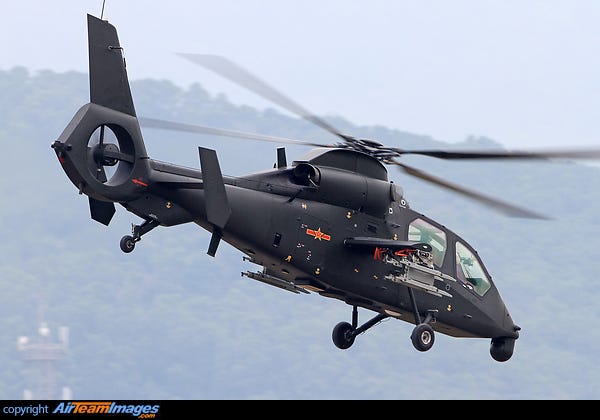
Next-Gen Helicopter: After spending $7 billion developing a reconnaissance and light attack helicopter, the US pulled the plug in 2004. China’s Harbin Z-19 is a tandem-seat helicopter for reconnaissance and light attack, with air-to-air and air-to-ground missiles and nose-mounted electro-optical target tracking turret.
Self-Propelled Howitzer: The Crusader was to replace the Army's aging artillery pieces, more mobile with longer range. It was canceled in 2002 after $2 billion was spent. China’s PLZ-05 155 mm self-propelled howitzer, the PLZ-07 122 mm self-propelled, self-loading howitzer, the PCL-181 155 mm wheeled, self-propelled, selfloading howitzer are all in full production.
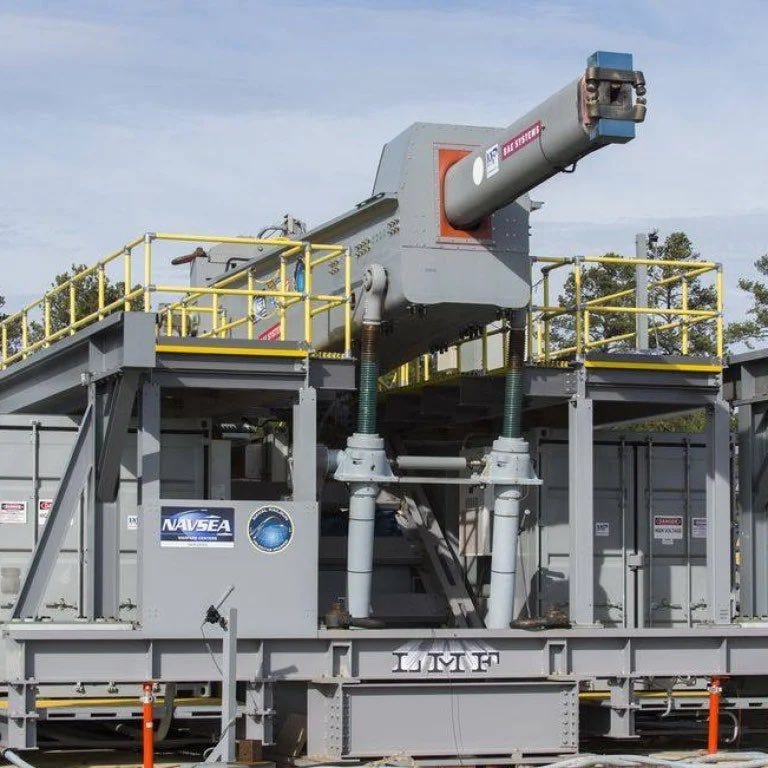
Railgun: 2021: The U.S. Navy spent $500 million on the railgun program and cancelled it in 2021. China’s railgun fires 120 rounds at 4,500 mph (7200 km/hr) and strikes targets. 120 miles (200 km) away. 2026: China’s railgun’s field-tested guidance system gives cheap hypersonic rounds mid-flight self-correction to strike moving targets hundreds of km away.
Laser Cannon: The Air Force spent $5 billion developing the laser cannon then cancelled it in 2012. China’s high-energy laser cannons remain powered up indefinitely without overheating, thanks to state-of-the-art cooling.
Next-Gen Destroyer: The Zumwalt next-gen destroyer was supposed to launch missiles from its 80 VLS cells but after spending $22 billion, the Navy canned it in 2016. China's Type 055 next-gen destroyer has 112 VLS cells, all of whose missiles vastly outrange and out-punch their USN counterparts.
ICBMs. The US Air Force paused work on its Sentinel intercontinental ballistic missile (ICBM) program to address escalating costs and restructure its acquisition strategy. Chinese and Russian cutting-edge missiles tilt the global nuclear balance in their favor.
Aircraft Carrier: Construction of the $20 billion USN Gerald Ford began in 2009. Its electromagnetic aircraft launch system, EMALS, is underpowered and unreliable, thanks to the Navy’s choice of AC electric power throughout the ship1. The Fujian, with a more powerful DC electric system, has a much more powerful, reliable EMALS, a bigger flight deck and aircraft elevators, a slimmer mast and a wider array of defensive weapons.
F-35 fighters from design to retirement, will cost $2 trillion, and each jet requires 9 hours of maintenance for one hour flying. The J-20 fighter carries a bigger payload (10 tons) faster (1,500 mph), higher (60,000 ft.) and further (1100 nm.) than the F-35. The J-20’s missiles outrange the F-35’s missiles by 50%.
New U.S. AIM-260 Missile is Too Expensive for the Fleet. A loadout of six missiles for an F-35 cost $35 million, and unprecedented ratio of missile cost to fighter cost.
The crisis
The West is suffering a crisis, not only of confidence, but of competence. Boeing’s failed shuttle is in the headlines but, less visibly, CERN’s $20 billion attempt to sustain nuclear fusion is collapsing under the weight of its own complexity. It will probably be abandoned now that a private Shanghai company has sustained fusion–for $1 billion.
Instead of continuing with this embarrassing list, I will devote the next post to consider more implications of the fusion breakthrough for world leadership.
Appendix
Malcolm Kyeyune: To a student of human history, the woeful state of America’s national security establishment does not appear as some sort of great mystery. It is far from unique; in fact, it might not even be noteworthy. It is just the normal stuff of human history, going back thousands of years. The USSR is still very much in living memory; what went on in that empire in its final decade wasn’t all that different from what is happening in America today. Despite all the hype, America’s empire is not actually very exceptional; it is far more similar to than different from history’s many other empires that have all risen to wealth and glory only to then fall away. Having foolishly succumbed to the slow-acting poison of an ideology that proclaims that America possesses the first and only nonideological military in the world, America’s civilian and military elites now find themselves trapped in a grim and decaying Wonderland of their own making. This article originally appeared in American Affairs Volume IX, Number 1 (Spring 2025): 213–27.
Notes
1 To get a sense of how massive this problem actually is, the 2022 Government Accountability Office report on weapon system sustainment for airframes is a good starting point. Almost every airframe type used by the services has growing and very serious sustainment bottlenecks. U.S. Government Accountability Office, “Weapon System Sustainment: Aircraft Mission Capable Goals Were Generally Not Met and Sustainment Costs Varied by Aircraft,” November 2022.
2 See, for example, Jerry Hendrix, “Sunk at the Pier: Crisis in the American Submarine Industrial Base,” American Affairs 8, no. 2 (Summer 2024): 22–34; U.S. Government Accountability Office, “Navy Readiness: Actions Needed to Address Costly Maintenance Delays Facing the Attack Submarine Fleet,” November 2018.
3 Though it is beyond the scope of this essay, it should nevertheless be noted that the extent of the current recruitment crisis is often severely understated in the media. The debates around this issue tend to focus on the military’s struggles to meet its on-paper authorized strength and its peacetime commitments. What’s less often talked about is that the U.S. military at present has essentially no realistic way to absorb and replace any casualties in real warfare: Katie Crombe and John A. Nagle, “A Call to Action: Lessons from Ukraine for the Future Force,” US Army War College Quarterly: Parameters 53, no. 3 (Autumn 2023): 21–31.
4 See, for example, David B. Larter, “‘You’re on Your Own’: US Sealift Can’t Count on Navy Escorts in the Next Big War,” DefenseNews, October 10, 2018.
5 Davis Winkie, “Broken Track: Why the Iron Knights Chose to Speak Out about Suicides,” Army Times, March 12, 2024; Janet Reitman, “A Disaster of the U.S. Military’s Own Making,” New York Times, June 19, 2024.
6 Sam Lagrone, “‘Poor Material Condition’ of Navy Amphib Fleet Prevent Marine Deployments, Training, Says GAO,” USNI News, December 3, 2024.
7 Leonard Wong and Stephen J. Gerras, Lying to Ourselves: Dishonesty in the Army Profession (Carlisle, Penn.: U.S. Army War College Press, 2015).
8 For those unfamiliar with this controversy inside the mid-2010s Navy, the award-winning ProPublica investigation is a good entry point: T. Christian Miller, Megan Rose, and Robert Faturechi, “Fight the Ship,” ProPublica, February 6, 2019.
The dual-band radar (DBR) aboard the Gerald R. Ford, the ship’s primary sensor system, struggled to perform during a pre-deployment and failed to provide constant radar coverage, partly due to the immense power required to operate DBR. The Navy is seeking to replace Ford’s DBR entirely.
in a recent US congressional hearing, one congressman waved a small plastic bag of screws and fasteners to an air force general and asked him the price. of course, he couldn't answer. the maintenance parts cost the US air force $90,000. you can get a lot more similar screws and fasteners for $9.99 at Home Depot.
Great