

Rumblings about China’s growing economic power have been heard for years. Actual steps to rein it in were kicked off on 1 December 2018, when a Huawei executive was arrested on espionage charges at Vancouver Airport. Two Canadian nationals were expelled from China in response. Chinese virologists were also sent home from Toronto. Restrictions were placed by Washington on technical exchanges.
Not to be outdone, the Turnbull government in Canberra jumped into the fray. First, Turnbull refused a licence for Huawei and a major Chinese dairy company to operate in Australia. He then imposed anti-dumping tariffs on Chinese steel and aluminium products. Foreign influence laws, obviously aimed at China, were then legislated in Canberra. The call for an inquiry into the source of COVID was then made by Turnbull’s undistinguished Foreign Minister Marise Payne. Coming as it did straight after her return from a visit to Washington, the Chinese naturally assumed she was put up to it by Trump. Very likely so, since Australia’s exports to China suffered and America’s did not. Richard Broinowski
Our leaders and media have vilified, calumniated, and threatened the PRC since I was a lad. Though Covid-19 was endemic in Europe and America long before it reached China, PM Scott Morrison loudly demanded a weapons-style inspection into its Chinese origins–then fell silent when the US refused to sign the UN resolution to investigate the source of the virus. When MP Shaoquett Moselmane repeated the WHO’s praise for China’s Covid response, Mark Latham MP called it ‘disgusting’ and, at dawn on June 26, 2020, forty police arrived at Moselmane’s home with sniffer dogs, took hair and dust samples from his car, searched the car engine and door rubbers, had a helicopter hovering and raided his parliamentary office, and froze the Moselmane family’s bank accounts while FM Peter Dutton told an interviewer, “You can’t have an allegiance to another country and pretend to have an allegiance to this country at the same time”.
Having invaded China itself in 1951, then attacked four of its neighbors, Australia became the first non-littoral country to criticize China’s behavior in the South China Sea, to demonize its Xinjiang and Hong Kong policies, to broadcast unsubstantiated allegations of Chinese cyber attacks and shelter ‘East Turkistan’ terrorists who murdered thousands of Chinese citizens. Says Lowy Institute’s Natasha Kassam, “No other country in the world – not Taiwan, Japan or South Korea – is talking about the likelihood of war on a day-to-day basis”.
The Fourteen Points
When China’s Embassy in Canberra listed fourteen of its worries, DFAT brushed them off, “The fourteen items identified by the Chinese embassy document are seen by the Department of Foreign Affairs as key to Australia's national interest and non-negotiable.. the government makes sound decisions in our national interest and in accordance with our values and open democratic processes”. Here are our most egregious offenses:
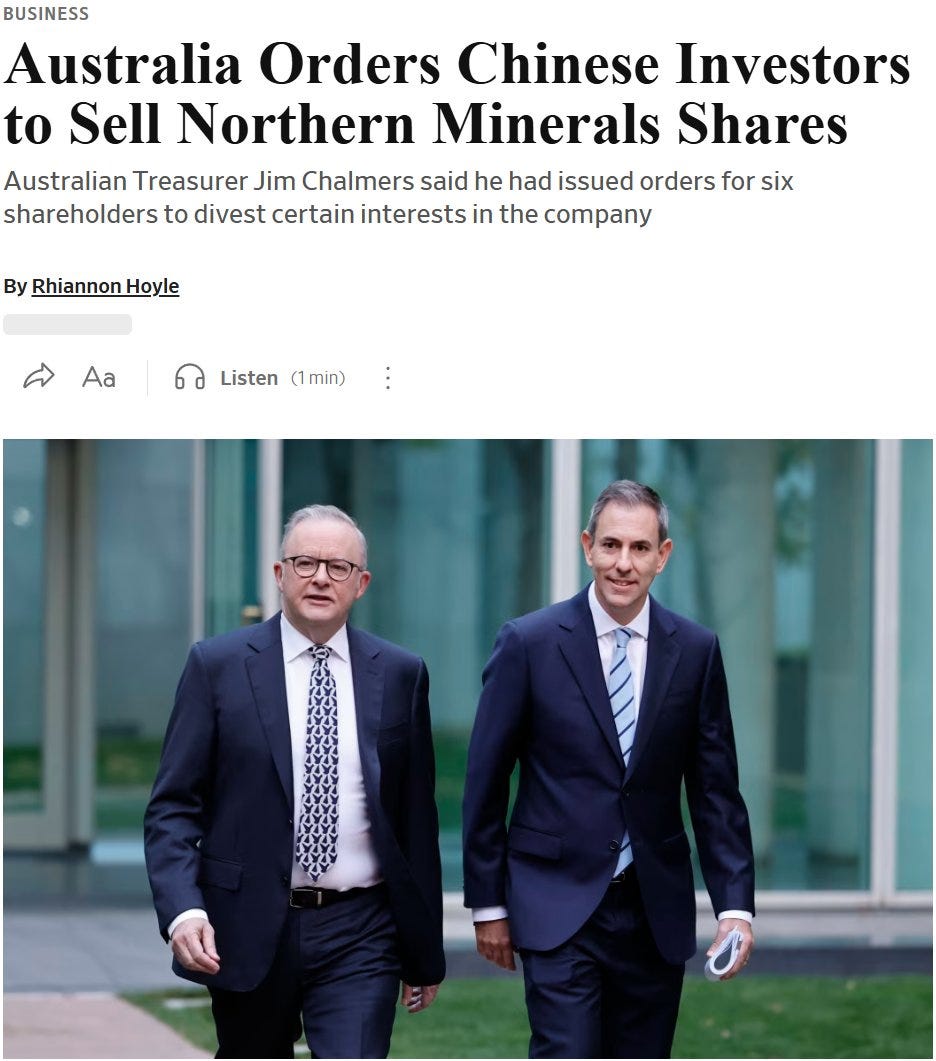
Blocking foreign investment decisions on opaque national security grounds in contravention of ChAFTA. More than 10 Chinese investment projects have been rejected by Australia since 2018, citing ambiguous and unfounded “national security concerns” and restricting areas like infrastructure, agriculture and animal husbandry.
Politicization and stigmatization of the normal exchanges and cooperation between China and Australia and creating barriers and imposing restrictions, including the revocation of visas for Chinese scholars.
Though the USA refused to permit one, calling for an international independent inquiry into the COV1D-19 virus in China as a political manipulation.
Incessant, wanton interference in Chinese Xinjiang, Hong Kong, and Taiwan.
Spearheading the crusade against China in multilateral forums, especially the UN.
Tough a non littoral country, Australia sided with the US anti-China campaign in making a statement on the South China Sea to the United Nations.
Spreading disinformation imported from the US around China’s efforts of containing COV1D-19.
Legislating scrutiny of agreements with a foreign government targeting China and blocking Victoria’s participation in B&R.
Funding anti-China think tanks like ASPI to spread untrue reports, peddle lies around Xinjiang and alleging China infiltration aimed at manipulating public opinion against China.
Early dawn search and reckless seizure of Chinese journalists’ homes and properties without charges, explanations or apologies.
Making thinly veiled allegations against China of cyber attacks without any evidence.
Outrageously condemning the governing party of China through NGOs.
Launching racist attacks on Chinese and Asian people.
Confecting unfriendly, antagonistic media reports about to poison the atmosphere of bilateral relations.
Banning Huawei Technologies and ZTE from the 5G network–despite Huawei’s offer to establish its security testing lab in Australia–over unfounded national security concerns, doing the bidding of the US by lobbying other countries and passing foreign interference legislation, in the absence of evidence, targeting China.
Given China’s pride in finally becoming a high tech exporter, our decision to ban Huawei was particularly cruel. Malcolm Turnbull not only led the charge against domestic adoption of Huawei, but lobbied the UK against it. Despite identical American, European and Australian laws, Turnbull claimed that Beijing can compel companies to provide information. When Huawei offered to base its network security division here–an asset of considerable intellectual value–the Government simply ignored it.
A History of violence
China’s mission to the UN had endured decades of Australia’s bad-faith dealings, negative discrimination and unprovoked hostility–backed by consistent opposition to China’s humanitarian proposals:

Since 2018, Canberra has rejected a dozen Chinese investments, citing ambiguous, unfounded ‘national security concerns,’ rejections that led directly to large Chinese losses, while placing infrastructure, agriculture and animal husbandry off-limits while launching a hundred anti-dumping and anti-subsidy investigations of Chinese products.
Our stigmatizing normal cooperation and imposing restrictions–like the revocation of Chinese scholars’ visas–caused a scandal in China, as did intimidatory predawn searches and reckless seizures of Chinese journalists' homes without charge, explanation or apology. The CSIRO did not renew its climate research partnership with the Qingdao National Marine Laboratory because ASIO’s Mike Burgess insisted that ocean temperature modeling could assist submarine operations against Australia–a decision roundly criticized even by Australian scientists.
From 2015-2020 China consistently lowered tariffs on our products to the point that ninety-five percent of our exports enjoyed zero duties, while Canberra imposed hefty duties on on their steel (144%), aluminium and chemicals.
Despite the Productivity Commission finding ‘no convincing justifications for the measures,’ we have launched one-third of our ongoing WTO actions and two-thirds of current measures against China. We initiated one-hundred six anti-dumping and anti-subsidy investigations of Chinese products yet complained bitterly when China finally resorted to the WTO for the first time with barley and wine tariffs.
If it maintains its current course, Australia’s long-term future with the new world leader and our neighbors in the world’s leading economic region looks bleak. Why?
Racism. As Gavin McGregor observed, racism changes our collective thinking. While not an overt premise (whoever says, ‘in this situation we should apply our racial prejudice’?), it changes what is ‘logical’ (vide our treatment of Adam Goodes). Chinese Australians report one hundred racist incidents each month, ninety-nine percent of which are ignored. As racist as Boers but lacking their refreshing bluntness, we deny that we are repelled by the thought of being led by yellow-skinned, slanty-eyed people.
Factionalism. Logic, commonsense, and national self-preservation are irrelevant to those whose only concern is funding reelections and who have always employed foreign threats to justify their advancement and our immiseration.
Capitalism. Socialist China’s sophisticated governance threatens the global capitalists who control our banks, media, and militaries and which our governments have always served.