

The CIA programs in Tibet, which were very effective in destabilizing it, did not succeed in Xinjiang. There were similar efforts made with the Uyghurs during the Cold War that never really got off the ground. In both cases you had religion waved as a banner in support of a desire for independence or autonomy which is, of course, is anathema to any State. US Ambassador Chas. H. Freeman, Director for Chinese Affairs, U.S. Department of State, 1979-1981. 8/31/18
In 1984, Beijing’s proposed continental land bridge from Xinjiang to Eurasia gave global strategic significance to the distant, rural province. But when construction of the first rail line to Kashi, co-terminus in Pakistan of the Karakoram Highway, Washington sprang into action.
The CIA hired terrorists who publicly declared the strategic rail lines were their target. Gulamettin Pahta, US-paid, Arlington-based leader of the ‘Uighur Liberation Front’, did not mince words. “The Continental Bridge is a Chinese imperialist plot that must be blocked.. They are building railroads, but the people are opposing the railroad, and will destroy the railroad. This is just like the American movies on the history of California. What the Indians did, in fighting the railroads, is what we will do. The same thing is happening. Every train coming into eastern Turkestan is bringing in Chinese. This must be stopped”. — Xinjiang in 1997.
Allegations of human rights abuses soon followed, alarming the Organisation of Islamic Cooperation:
The Commission was briefed on the human rights situation of Uyghur Muslims in China, which shows rising discrimination on the basis of their religion by subjecting them to involuntary conversions in detention camps where they were forced to follow and adopt cultural values and practices contrary to their religious beliefs. The OIC Islamophobia Observatory informed IPHRC that Chinese authorities call these camps as re-education centers to combat violence and extremist ideologies. According to the OIC Islamophobia Observatory, the newly introduced Chinese law namely the Xinjiang Uyghur Autonomous Region DeRadicalization Regulations (in October 2018), was excessive in nature as virtually any activity could fall within the scope of its provisions and enables the authorities to justify the presence of detention/re-education camps.
The Commission expressed concern on these disturbing reports on the treatment of Uyghur Muslims and expressed hope that China, which has excellent bilateral relations with most OIC countries as well as the Organization of Islamic Cooperation, would do its best to address the legitimate concerns of Muslims around the world. The Commission also recalled that the Constitution of China provides clear and full guarantees for the right to freedom of religion and belief, which makes it obligatory on its authorities to ensure the exercise of these rights
by all its nationals. The Commission further emphasized the importance of ensuring promotion and protection of human rights and due process guarantees while countering terrorism — Organisation of Islamic Cooperation, December 2018.
China promptly invited the OIC to observe the Xinjiang situation themselves and, in March 2019, after the inspection, the OIC reported:
The Council welcomes the outcomes of the visit conducted by the General Secretariat’s delegation upon invitation from the People’s Republic of China; commends the efforts of the People’s Republic of China in providing care to its Muslim citizens; and looks forward to further cooperation between the OIC and the People’s Republic of China.” Report, Item 20.
James Wood’s Update
Sustained Terrorist Violence
For years, Western media pushed a simple story about Xinjiang: China is committing genocide. That story collapses once you look at the facts.
From the 1990s through to the mid-2010s, Xinjiang was hit by sustained terrorist violence: bombings, mass stabbings, police assassinations, attacks on civilians, mosques and markets. This wasn’t abstract. People were being murdered in public spaces. Uyghurs, Han Chinese, police officers, elderly people, children — all were victims.Groups linked to the East Turkistan Islamic Movement (ETIM/TIP), listed by the UN Security Council as a terrorist organisation, openly pushed separatism and violent jihad. By 2013–2014, attacks had escalated into mass-casualty incidents that shocked the entire country.
Prevention, The First Strategy
China looked at that situation and reached a blunt conclusion: Reactive counter-terrorism doesn’t work. Arresting people after civilians are already dead doesn’t prevent the next attack. So Beijing shifted to a prevention-first model. Cells were dismantled. Weapons caches were seized. Recruitment networks were shut down. Extremist propaganda was criminalised. Security was saturated across public spaces. And yes, vocational and deradicalisation centres were established for people assessed as being on the path toward radicalisation.The goal wasn’t subtle and it wasn’t liberal. It was simple: Stop the violence before it happens.
Results: Terrorism’s Collapse
Now look at the outcome. From the late 2010s onward, large-scale terrorist attacks in Xinjiang collapsed to near zero. The knife attacks, bombings and mass-casualty incidents that had plagued the region for years disappeared. Police deaths dropped sharply. Markets, transport hubs and daily life normalised. Even critics and UN reporting don’t dispute this basic fact: the wave of terrorism ended.
Western vs. China’s Counter-Terrorism
Compare that with the West. In the US and Europe, terrorism is managed almost entirely after the fact — intelligence failures, attacks, emergency response, long prison sentences. Radicalised individuals cycle through courts and prisons with minimal ideological disengagement. The result? Repeated attacks, copycats, prison radicalisation and endless “lone wolf” incidents. France, the UK, Belgium, the US — none can claim they’ve solved terrorism.China chose a different path. Instead of letting radicalised individuals drift toward violence or warehousing them indefinitely in prisons, China attempted forced disengagement and reintegration.
The Reality of ‘Re-Education’ Centres
The centres, lazily branded “concentration camps” in Western discourse, were not death camps, not extermination sites and not designed for mass killing. They were coercive, yes, but they focused on language, law, job skills and breaking violent ideological conditioning.The logic was blunt but pragmatic: It’s better to redirect someone than to let them become a murderer, or die as one.
The Genocide Claim Falls Apart
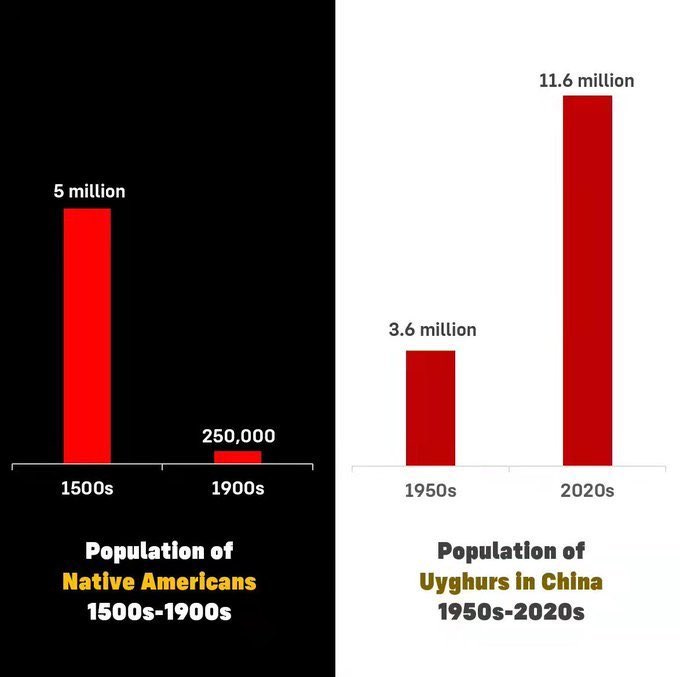
There is no evidence of mass killing. No mass graves. No extermination infrastructure. Even the UN’s own 2022 human rights assessment did not label the situation genocide. It raised serious concerns, but genocide was not its conclusion. Even census data shows Xinjiang’s population grew between 2010 and 2020 and the Uyghur population increased over that same period. That alone destroys claims of extermination. Critics then pivot to falling birth rates in some Uyghur-majority areas after 2017 — a real statistic — but birth-rate decline is not population destruction and it is not genocide.
The Inconvenient Truth
What’s really happening is far less dramatic and far more inconvenient: China prioritised certainty over liberal risk, prevention over reaction, and rehabilitation over endless punishment. The system was heavy-handed, but it achieved something Western counter-terror models repeatedly fail to do: It stopped mass terrorist violence.Re-educating and reintegrating people, even coercively, is fundamentally different from bombing countries, exporting wars, or cycling radicals through prisons until the next attack. Teaching skills and enforcing civic participation is not the same thing as destroying a people.You can debate proportionality. You can debate rights. But you cannot honestly claim China chose chaos, extermination, or collapse.
Conclusion
The West didn’t lose the Xinjiang narrative because China “hid the truth.” It lost because the violence stopped — and that outcome doesn’t fit the narrative.
Note: Some cases and footage are released to the public for the very first time and contains footage which some viewers may find disturbing.
Videos
Fighting terrorism in Xinjiang (Viewer discretion advised).
2: ETIM and terrorism in Xinjiang
3: Memories of fighting terrorism in Xinjiang:
4: War in the shadows: Challenges of fighting terrorism in Xinjiang
James Wood, @commiepommie, is a British-Australian living in China, is a geopolitical analyst, and author of China in Focus.
Great review! It is sad that the WMSM will never carry this excellent piece.