

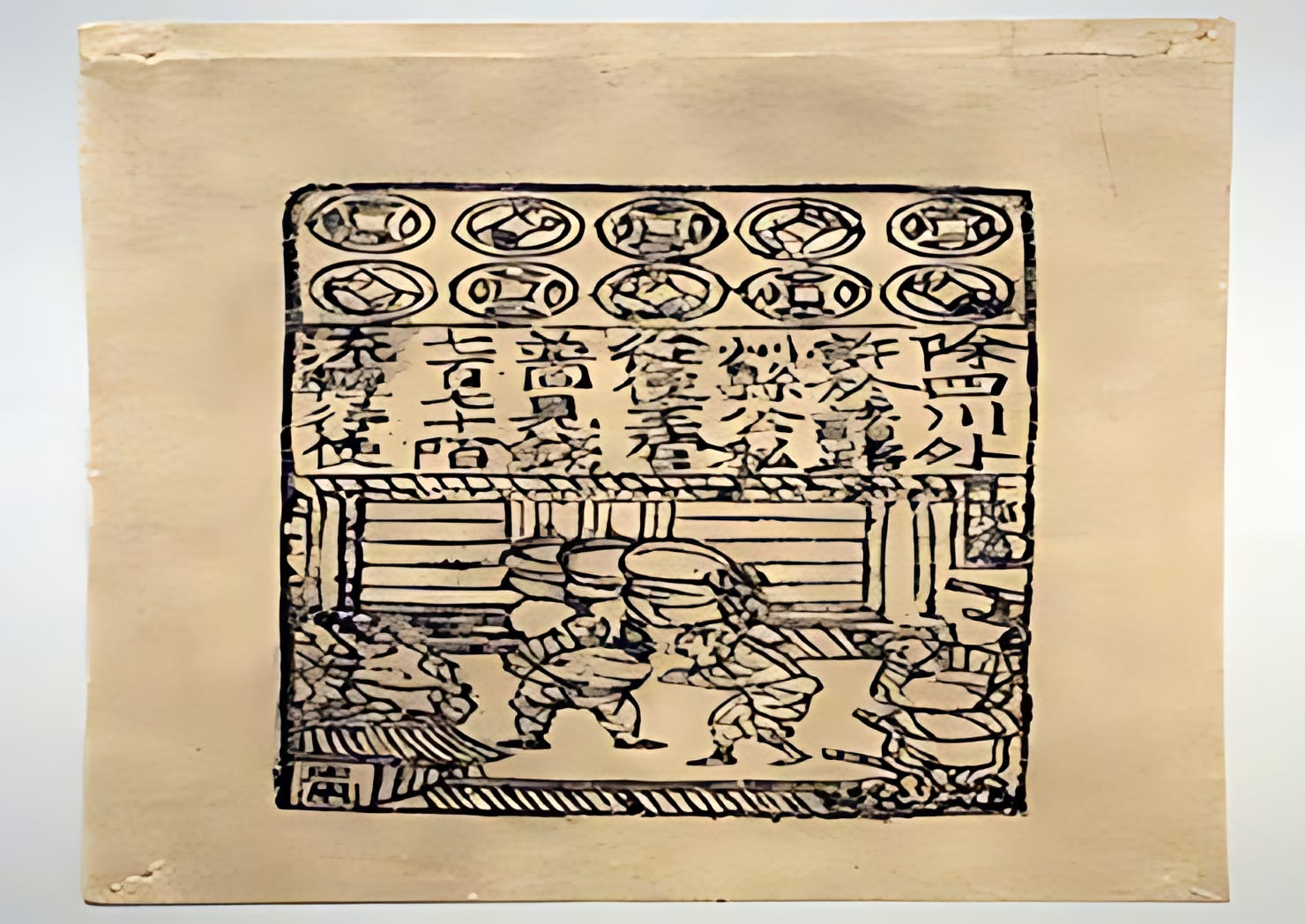
China is again the richest country on earth and its currency again so sought-after that, to compete, the US Treasury must pay twice the interest of RMB bonds. The PRC’s money-management is the fruit of thousands of years of experimentation by sophisticated officials, as these excerpts demonstrate.
Paper Currency
In modern monetary theory, everything that performs the functions of money is money. According to this definition, not only cash currency “the circulating treasure”—but also the various sorts of paper money in widespread use were money, even though many Song scholars refused to accept this reality.
Song paper money was the first viable paper currency system used in a national economy in world history, though not a single authentic specimen is known to exist today. The Mongols adopted paper money almost two decades before they defeated the Song. The “silk notes” they issued in i260, which were backed by silk yarn, reached Persia in 1294 and Korea in 1296. The Japanese created their own paper currency in 1334, and the Vietnamese adopted paper in 1396.
In Western countries, paper money was a rather late arrival. It started in Sweden in 1661 and was adopted in America in 1690, France in 1720, Russia in 1768, England in 1797, and Germany in 1806. Paper currency came into use in Song times because several preconditions were met.
The Song’s flourishing national economy created a high demand for iron and copper in the production of all sorts of articles, and the introduction of paper money helped to free up these metals for use in manufacturing.
The technology for printing paper notes became so advanced that currency could be printed in good quality (mak-ing counterfeiting difficult) and in high numbers.
Song scholars who paid attention to the monetary system had a very good understanding of money as a means of payment and exchange, not as a i value in its own right, in the way that silver or gold was valuable.
As Ye Shi (1150—I223 ) explained, “Money, one of those magic things created by man, is useful to its creator only when it is in constant circulation; it loses the meaning of its existence when it is taken away from the market and locked up in an iron-chest.”’ In his view, ease of circulation was the very function of currency, and paper money fulfilled this function better than coins.
But perhaps the most critical factor in the growth of paper currency had to do with the Song’s foreign policy. The government constantly feared that bronze coins, with their high percentage of copper and a face value worth less than the actual metal they were made of would be taken out of circulation, particularly by the Song’s northern and western neigh-bors. The resulting shortage of cash would damage the national economy
Paper money
While strengthening alien regimes, the stability of the Liao dynasty’s economy in particular depended heavily on cash imports from the Song. To keep control of metals and safeguard the stability of its currency, the Song government established segregated currency zones in the border regions. In the 1040s iron cash was extended to all the frontier provinces bordering the Liao and Xi Xia dynasties and copper cash was prohibited. In the middle of the twelfth century the Jin also tried to safeguard their own currency system by prohibiting the use of copper cash in border provinces, especially in the affluent Huainan region.
Low-value currency zones on both sides of the border not only made the lives of commoners in these regions more difficult but also complicated all nationwide commercial activities and tax administration.
The first promissory note
The earliest privately issued “order to pay,” promissory note or exchange bill, was issued in 994 AD . This note or ‘bill’ was a privately agreed-upon deed, and the earliest mention of it was in the context of the uprising of Li Shun, the leader of a short-lived insurrection of craftsmen, artisans, and farmers in Sichuan province.
These insurgents objected to the heavy iron coins that had replaced the small copper coins in use for thirty years. In response to this unrest and after further administrative irregularities, the government established a Bureau for Exchange Bills in 1023 in modern Chengdu and introduced the official exchange bill—a clever, highly efficient, profitable, and comfortable invention for buying and selling goods and services.
This piece of printed paper entitled its holder to receive the amount of cash strings printed on the surface of the exchange bill when he presented it at one of the bureaus. Originally, one exchange bill was one string’s worth of cash and was valid for a circulation period of three years. Later, the printed exchange value could vary between one and ten strings, and exchange rates of 770 coins and less per string became common.
For merchants who needed a large amount of cash to purchase commodities, paper bills immensely facilitated the transfer of funds from one place to another. Nobody had to carry bulky, heavy iron coins over dangerous mountain paths. Very soon the new exchange medium found its way into regions of the north, as merchants and officials saw its value in solving a number of problems related to commodity transfer and payment.Paper money was made from the bark of the paper mulberry tree, which is why it was also called mulberry paper money.
The government manufactured, issued, and controlled paper notes, starting with the raw material and continuing through distribution. Usually silk or other fibers were mixed in to make counterfeiting as difficult as possible. Both the Northern and Southern notes had elaborate and difficult-to-copy patterns and usually bore technical data (date and series of issue, serial number, exchange value in strings, time limit of circulation, seal stamps, and so on) verifying the genuineness of the printed paper.
Counterfeiting
The punishment for counterfeiting bills was usually printed on the note: “By imperial decree: Criminals who counterfeit paper money are to be punished by beheading. The reward [for informers] shall be 1,000 guan.” The government-run Chengdu printing house was established in 1068, and in the late twelfth century the treasury near Hangzhou employed 204 craftsmen. The size of a single note may have measured 11 by 19 centimeters. Exchange bills—and, later, money vouchers—were multicolor prints using multiple impressions.
For better control of use and distribution, the government set up restrictions and conditions for the issuance and circulation of exchange bills. From 1023 until 1107 the Song government circulated forty-three issues, each limited to a total worth of 1,256,340 strings per circulation period (which was three years until 1069). A liquidity backing of 360,000 strings (or 28 percent) per circulation period helped to avoid insolvency. After three years the old exchange bills had to be replaced by new ones or exchanged for cash. A handling fee of 30 coins was charged for each string paid out and each order renewal.
Fractional Reserves & Fiat Money
Liquidity backing was decisive in the early success and the later failure of paper currency. Toward the end of the eleventh century some scholars insisted on 100 percent liquidity backing, while others erroneously thought that the convertibility problem could be solved by introducing a fixed rate of exchange from paper to cash and vice versa. Some scholars insisted that the government should maintain a cash reserve as liquidity backing. Emperor Shenzong thought liquidity backing for exchange bills was unnecessary, because income and expenditures would cause the people to trust the value of money. He held the strikingly modern opinion that the economic power of a national economy was sufficient backing for paper currency.
His advisers did not agree.In 1071, after some of Wang Anshi’s fiscal reforms were put into practice, the demand for exchange bills doubled. Six-year circulation was introduced shortly thereafter, and in 1093 the whole system started to run out of control when exchange bills equal to 13.3 million strings of cash were issued. In 1105 a reform, effective with the forty-fourth circulation, was issued. In 1107, the exchange bill was replaced with the money voucher. The bureaus were renamed accordingly.At the end of the Northern Song in 1127, the total number of old exchange bills in circulation may have amounted to about 70 million strings. When the Song Chinese began their southward migration, the old credit line no longer satisfied demand.
The total worth of money vouchers had to be increased by 30 percent to 1,886,340 strings of cash, and in 1141 the sixtieth issue climbed to an inflationary 5,886,340 strings. In 1145, after the Song had come to an agreement with the Jin and political security at the northern border eased the strain on state finances, the government reduced the issue of money vouchers to the old figure of 1127.
It would not last long.
The Age of Confucian Rule: The Song Transformation of China, by Dieter Kuhn.

This is wonderful, thank you. It is such a delight to see paper money and complex societal and economic maneuvers, and at such scale, pushed earlier by so many centuries.
Thanks for the interesting article. What is shown is a mirror image of the objest. That is, it should be flipped horizontally. Then most of the Chinese characters become legible. For instance, the four characters in the right-most column say "Except (the Province/Region of) Sichuan". The artwork and the calligraphy of the characters is poor. Plus, the fact that some of the characters are not quite legible/recognizable leads me to suspect the object might not be genuine.